


Solar savings in Illinois can look simple at first, but the rules change depending on your utility, income, system, and timing. That makes it easy to leave money on the table or assume a program applies when it doesn’t.
I know how confusing that can feel when several offers use different terms. Illinois solar incentives include state programs, utility rebates, bill credits, and tax benefits, but each one works differently.
Here, you can see which options may fit your situation, how the main programs work, what affects your savings, and what to check before signing a contract. I also explain why timing, ownership, and eligibility matter when comparing solar offers.
What Solar Incentives Does Illinois Offer?
Illinois does not have one single solar incentive program that applies to every homeowner. Instead, the state offers several different programs and benefits that can reduce solar costs in different ways.
Illinois Shines helps lower installation costs through Renewable Energy Credits (RECs), while Illinois Solar for All supports income-eligible households, renters, and nonprofits with affordable solar options. ComEd and Ameren Illinois also offer utility-specific rebates for qualifying solar and battery systems.
Beyond upfront savings, net metering can reduce electricity costs by providing credits for extra power sent back to the grid, and property tax benefits can help prevent added solar value from increasing your tax burden.
Each incentive works differently, and not every homeowner qualifies for the same benefits. Your utility provider, income level, system details, and installation type all affect which programs are available to you.
For example, a ComEd customer may have access to rebates that someone served by another utility does not. Income also creates different paths, with Illinois Solar for All serving eligible households while programs like Illinois Shines are generally used by homeowners following the standard solar process.
How Do Illinois Solar Incentives Actually Work?
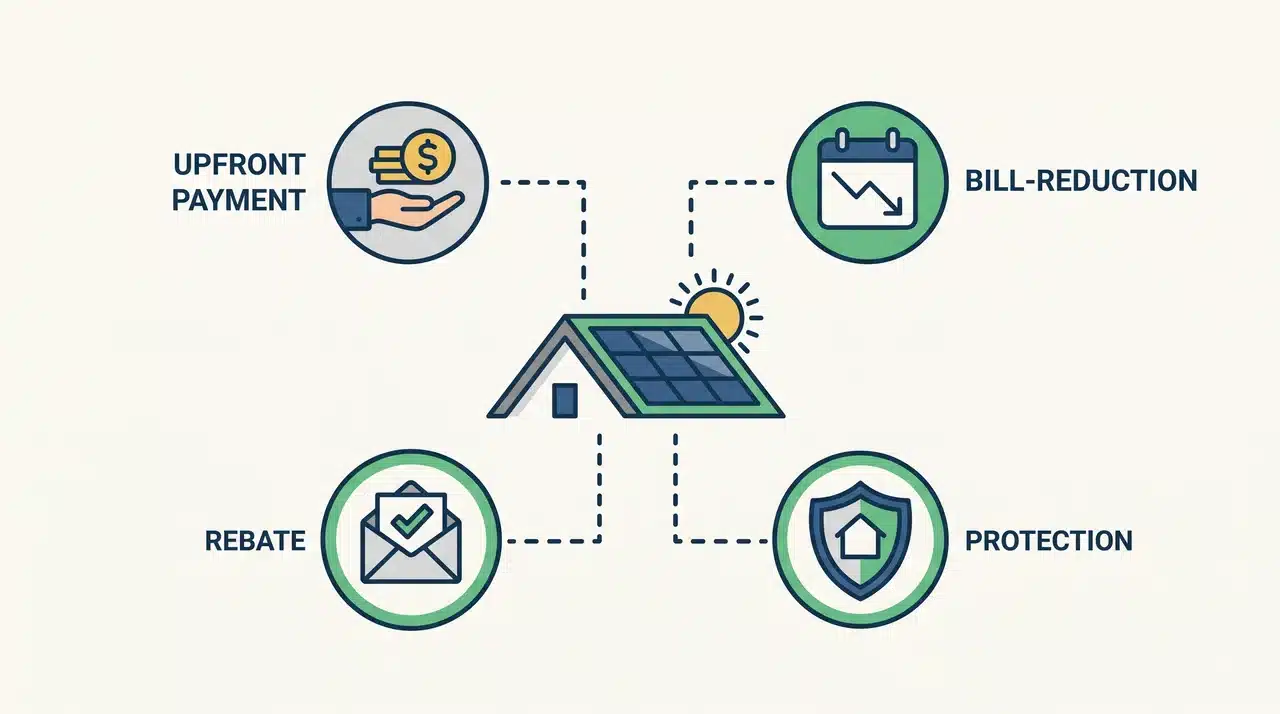
Illinois solar incentives don’t all work the same way. Some pay you upfront. Others lower your bill over time, and some just protect you from extra costs down the line.
Knowing how each one works stops you from assuming every incentive applies to your project.
1. Illinois Shines (SREC Payments)
Illinois Shines provides an upfront payment based on the Renewable Energy Credits (RECs) your solar system is expected to generate. However, that payment is not a fixed amount for every homeowner because it depends on program pricing and when your project enters the program.
Your solar system earns RECs based on its expected electricity production over time. An approved vendor receives payment for those credits and usually passes that value to you by reducing the overall cost of your solar installation upfront.
The part many homeowners miss is that REC pricing is divided into different blocks. When one block reaches its limit, Illinois Shines moves to the next one, which may have a different payment rate. This means applying earlier can help secure a better REC value before pricing changes.
Timing and paperwork also matter. Delays with vendor approval, documents, or project completion can move your application into a later block with a lower payment.
Illinois Shines is not a direct check from the state to homeowners, and the final benefit depends on your installer agreement, project approval, and when your application moves through the process.
2. Illinois Solar for All (ISFA)
Illinois Solar for All is designed for households, renters, and organizations that may not otherwise be able to afford solar. Unlike some other solar programs, it is not available to every homeowner because eligibility is mainly based on income.
If your household income is around 80% or less of the area median income, you may qualify for the program. Approved solar companies must also guarantee electricity bill savings for eligible participants, making those savings a required part of the program.
The program is not limited to homeowners with their own roofs. Renters can participate through community solar options, and nonprofits and public organizations may also qualify. This makes Illinois Solar for All useful for people who cannot install panels on their own property.
For households above the income limit, this program usually is not the right fit. Those homeowners generally look at options like Illinois Shines and utility rebates instead, since these programs follow a different eligibility path.
3. ComEd and Ameren Distributed Generation Rebates
ComEd and Ameren Illinois each offer their own solar and battery rebates, but these programs are separate from Illinois Shines. Whether you can use them depends entirely on which utility serves your property.
For eligible customers, the rebate is currently worth $300 per kW of installed solar capacity. Adding qualifying battery storage can add another $300 per kWh of storage capacity, helping reduce the upfront cost of a combined solar-and-storage project. A typical 5 kW system, for example, would earn around $1,500 from the solar portion alone.
The main limitation is location. Only customers within ComEd or Ameren Illinois service areas can access these specific rebates. If another utility supplies your electricity, you will need to look into different programs available in your area.
These rebates also come with technical requirements, such as approved equipment and smart inverter standards.
It is also important to remember that utility rebates and Illinois Shines REC payments are separate benefits, so a project may qualify for both rather than having to choose between them.
4. Net Metering and Property Tax Benefits
Unlike upfront solar payments, net metering and property tax benefits work in the background after installation, reducing ongoing costs instead of paying out once.
Net metering credits you for extra power your panels send to the grid, but the value depends on when your system was connected, and the rules changed in 2025.
- Connected before January 1, 2025: You’re “grandfathered” into full retail-rate net metering. Exported power is credited against your entire bill, including supply and delivery, for the life of the system.
- Connected on or after January 1, 2025: You’re enrolled in supply-only net metering (Smart Solar Billing). Credits apply only to the supply portion of your bill, not delivery charges or fixed fees, roughly half the per-kilowatt-hour value of the old rate.
- Property tax treatment: Solar panels can raise your home’s value, but Illinois rules prevent that added value from increasing your property tax bill. Unlike net metering, this benefit shows up at assessment time, not on your monthly electric bill, and some counties require homeowners to file paperwork to claim it.
What Illinois Solar Incentives Are Not
Before comparing savings, it helps to understand what Illinois solar incentives do not cover. Many homeowners misunderstand how these programs work, especially when it comes to eligibility, ownership, and combining different benefits.
- Illinois solar incentives are not one single package: Illinois offers several separate programs, but you do not automatically qualify for every available benefit. The incentives available to you depend on factors like your income, utility provider, and solar project details.
- Incentives do not work like a free selection menu: Each program has its own eligibility rules, and some benefits serve different groups. For example, some homeowners may qualify for Illinois Shines and utility rebates, while income-eligible households may qualify for Illinois Solar for All instead.
- “Free solar panels” does not always mean free ownership: Illinois Solar for All is a legitimate state program, but some private companies use similar wording for leases or power purchase agreements. Before signing, check who owns the system, what payments you are responsible for, who handles maintenance, and what the contract terms require.
- Illinois incentives are separate from federal solar credits, and the federal picture changed: State programs and utility rebates follow their own rules, separate from the federal government. That distinction matters more now than it used to: the 30% federal residential solar tax credit (Section 25D) expired for systems purchased with cash or a loan after December 31, 2025.
If you buy your system outright in 2026, there is no federal credit to add to your Illinois savings. The one federal path still open is a solar lease or power purchase agreement, where the company that owns the system can claim a separate business credit (Section 48E) through 2027 and may pass some of that value along through a lower monthly rate. Confirm which ownership structure you’re using before assuming any federal savings apply
Knowing these differences can help you avoid misleading offers and set realistic expectations about your solar savings. The next step is looking at how much these incentives can actually reduce your overall costs.
How Much Can Illinois Solar Incentives Reduce Your Costs?
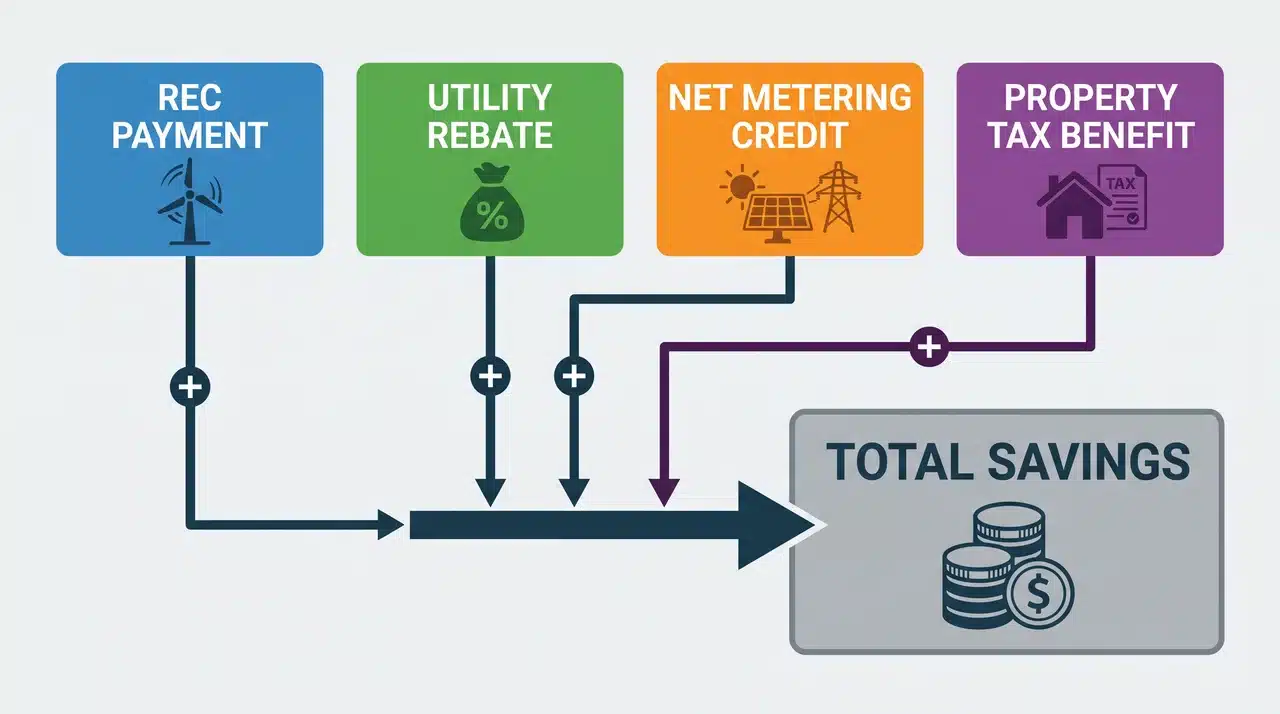
The savings from Illinois solar incentives can vary widely because there is no single amount that applies to every homeowner. The value depends on which programs you qualify for, how your solar system is set up, and the rules that apply when your project is installed.
For example, one homeowner may receive value from Illinois Shines along with a utility rebate, while another may qualify for Illinois Solar for All and follow a completely different savings path. The biggest savings usually come from combining the right programs rather than relying on one incentive alone.
Here are the main ways Illinois incentives can reduce your solar costs:
- Illinois Shines: Provides an upfront REC payment based on your solar system’s expected energy production.
- Utility Rebates: ComEd and Ameren customers may receive rebates for qualifying solar and battery systems.
- Net Metering: Helps reduce electricity costs by providing credits for excess solar energy sent back to the grid.
- Property Tax Benefits: Helps prevent added solar value from increasing your property tax burden.
The final savings amount changes from one household to another because several factors come into play. Your utility provider, system size, installation date, roof conditions, electricity usage, financing method, and income eligibility can all affect the total value you receive.
Why Timing Matters for Illinois Solar Incentives
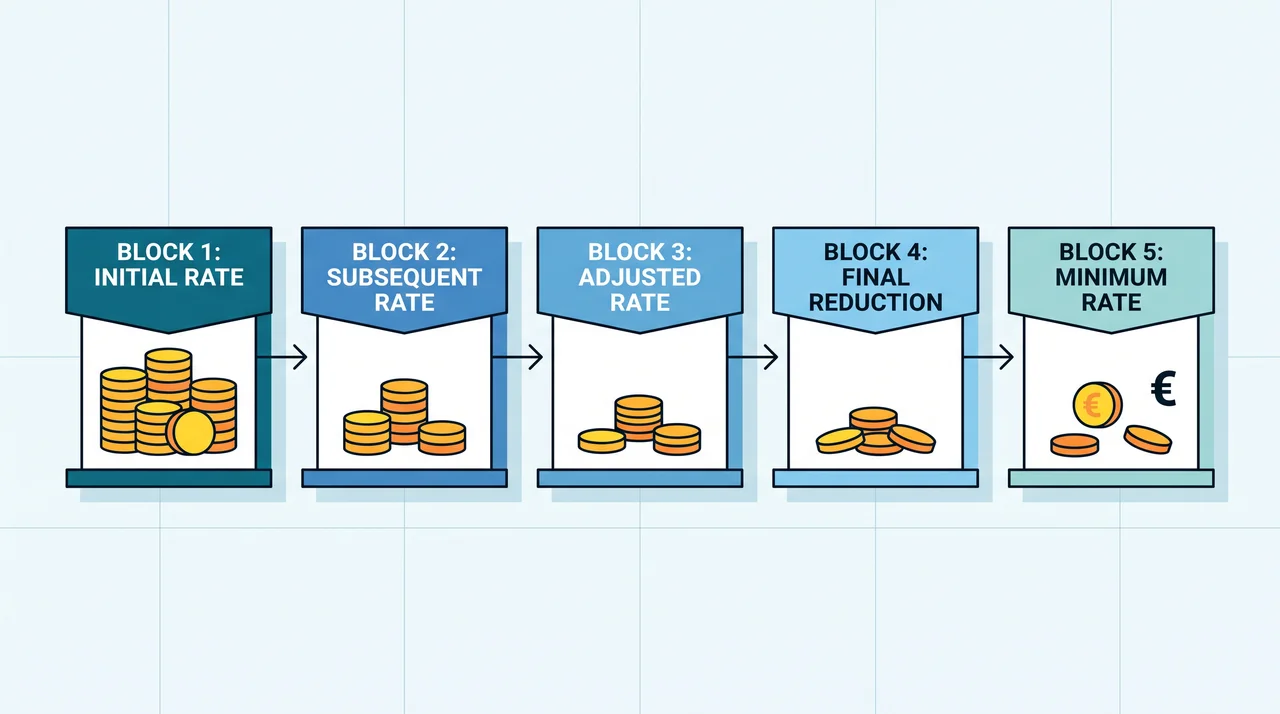
Timing can play an important role when applying for Illinois solar incentives because program values and requirements can change over time. Illinois Shines uses pricing blocks that fill as more solar projects are approved.
Once a block reaches its limit, the program moves to the next one, which may offer a different REC payment rate.
Utility rebates also operate on their own schedules. Programs from ComEd and Ameren Illinois can be affected by available funding, participation levels, and updated program requirements. Changes to state or federal rules can also impact the benefits available for new solar installations.
Waiting does not always mean you will lose access to incentives, but it can change the value you receive.
Before signing a solar contract, check the latest program details and confirm that the incentives included in your estimate are still available.
How to Check Which Illinois Solar Incentives You Qualify For
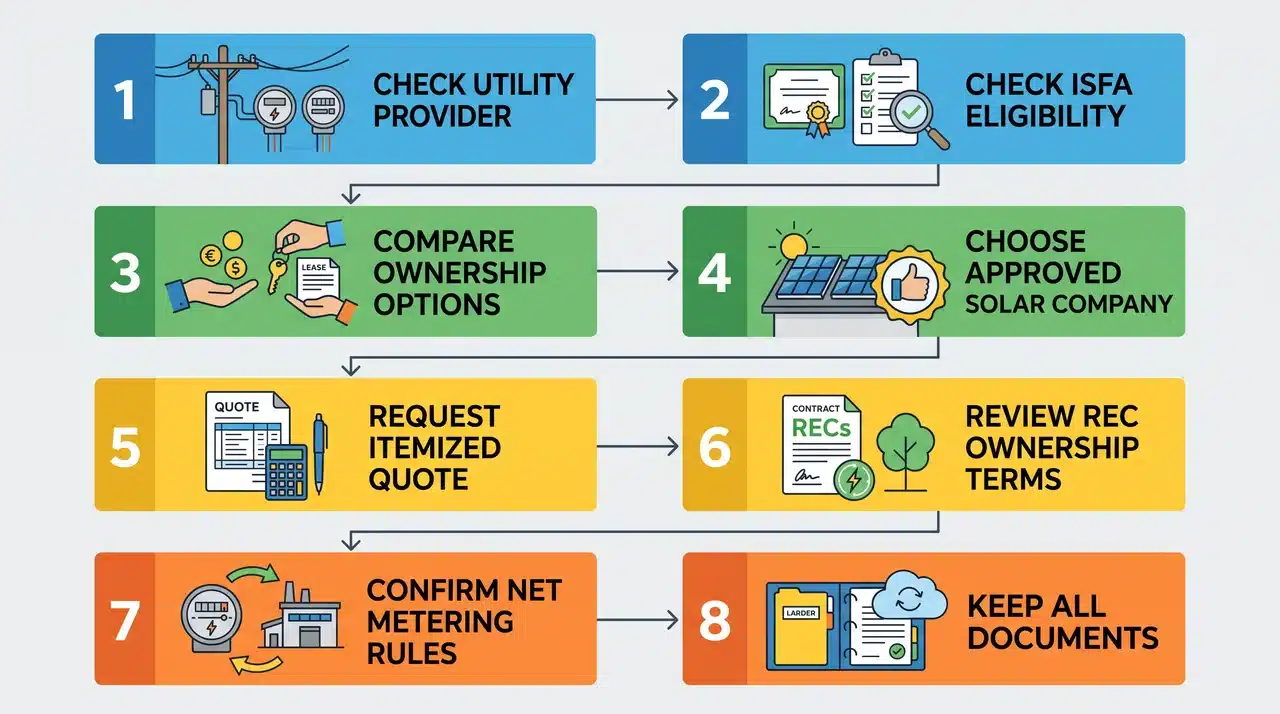
Finding the right Illinois solar incentives does not have to be complicated, but checking the details before installation can save you from unexpected costs later. Start by understanding which programs match your situation, then confirm the requirements before signing any agreement.
- Check your utility provider: ComEd and Ameren Illinois offer their own solar and battery rebate programs. Your utility company determines whether you can access these incentives, since customers outside their service areas may need to look at different options.
- Check Illinois Solar for All eligibility: This program is based mainly on household income. If you qualify, it can provide a different solar savings path than standard incentives like Illinois Shines or utility rebates.
- Compare ownership options: Cash purchases, solar loans, leases, and power purchase agreements handle costs and incentives differently. Knowing who owns the system helps you understand who receives certain benefits.
- Choose an approved solar company: Programs like Illinois Shines require participation from approved vendors. Working with a qualified installer helps ensure your paperwork and incentive applications are handled correctly.
- Request an itemized quote: Ask your installer to separate the system cost, Illinois Shines value, utility rebates, financing costs, and expected savings. This makes it easier to compare offers and avoid unclear pricing.
- Review REC ownership terms: Some solar agreements transfer Renewable Energy Credits to the installer in exchange for lowering your upfront cost. Make sure you understand what you are giving up before signing.
- Confirm net metering rules: Net metering benefits depend on your utility provider and installation date. Checking the current rules helps you understand how much credit your excess solar energy may provide.
- Keep all documents: Save your contracts, invoices, approval letters, and program records. These documents can be useful for tax purposes, future home sales, or resolving incentive-related questions.
Taking these steps before installing solar gives you a clearer view of which incentives apply, what savings to expect, and what terms you are agreeing to.
Is Solar Worth It in Illinois in 2026?
Solar can still be a smart financial choice for many Illinois homeowners, but the answer depends on your property, electricity usage, available incentives, and how you pay for the system. No single savings estimate works for everyone.
Solar may be worth considering if:
- Your roof is in good condition: A roof with enough remaining life helps you avoid paying for repairs or replacements soon after installing panels.
- Your property gets good sunlight: Less shading usually means better solar production and stronger long-term savings.
- You qualify for multiple incentives: Combining programs like Illinois Shines, utility rebates, and other available benefits can improve the overall value.
- You plan to stay in your home: The longer you use the system, the more time you have to recover the upfront cost.
Solar may not be the best option if:
- Your roof needs replacement soon: Installing panels before major roof work can add extra costs and complications.
- Your property has heavy shading: Limited sunlight can reduce how much electricity your system produces.
- Financing costs are too high: Loan fees or high interest rates can reduce the savings from available incentives.
- You plan to move soon: Selling your home before reaching the break-even point may limit your financial benefit.
Before making a decision, compare the expected savings, incentives, and long-term costs. A reliable installer should explain how the numbers work for your home instead of only focusing on system size and price.
Conclusion
Solar savings in Illinois depend on more than finding the biggest rebate. You need to match each program with your utility, income, system, ownership setup, and installation timing.
Illinois solar incentives can lower upfront costs, reduce electric bills, and protect you from added expenses, but the value is different for every household.
The safest approach is to compare quotes, confirm eligibility, review REC ownership, and check current net metering rules before signing anything.
That gives you a better sense of the real savings and helps you avoid offers that sound better than they are. If solar fits your home and budget, use these points to compare installers and make a more informed choice.
Frequently Asked Questions
How much can Illinois solar incentives save homeowners?
The savings vary based on your utility provider, solar system size, installation date, and which programs you qualify for. Incentives may reduce upfront costs and lower long-term electricity expenses.
Can I combine Illinois Shines with ComEd or Ameren rebates?
In many cases, homeowners may use Illinois Shines along with utility rebates, but eligibility depends on your utility, system requirements, and program rules. Check the details before signing an agreement.
Do renters qualify for solar incentives in Illinois?
Yes. Renters may access solar benefits through community solar programs, including options available through Illinois Solar for All if they meet the eligibility requirements.
What should I check before signing a solar contract in Illinois?
Review the total cost, incentive details, REC ownership terms, financing agreement, and expected savings. Make sure every benefit is clearly explained before moving forward.