


Choosing between two solar panels can feel simple until the numbers start telling different stories. One panel looks better on paper, while the other appears cheaper at first.
I know that makes the decision harder than it should be. The difference between monocrystalline and polycrystalline solar panels comes down to how their silicon cells are made and how that affects efficiency, heat loss, roof space, appearance, and total system cost.
Once you understand those differences, you can judge which option fits your property instead of relying on color or price alone. You will also see why panel count, climate, shading, and installation design matter just as much as the efficiency rating.
Difference Between Monocrystalline and Polycrystalline Panels and Where It Begins
Monocrystalline solar panels use cells made from one continuous silicon crystal. Their uniform structure allows electrons to move through the cell with less resistance.
Polycrystalline panels are made from several silicon crystals that form together as melted silicon cools. The boundaries between those crystals create additional resistance, slightly reducing the cell’s ability to convert sunlight into electricity.
This difference gives monocrystalline panels higher efficiency and better power output per square foot. Polycrystalline panels usually require more surface area to produce the same amount of electricity.
| Feature | Monocrystalline Panels | Polycrystalline Panels |
|---|---|---|
| Silicon structure | One continuous crystal | Multiple silicon crystals |
| Typical efficiency | 18%–24% | 13%–17% |
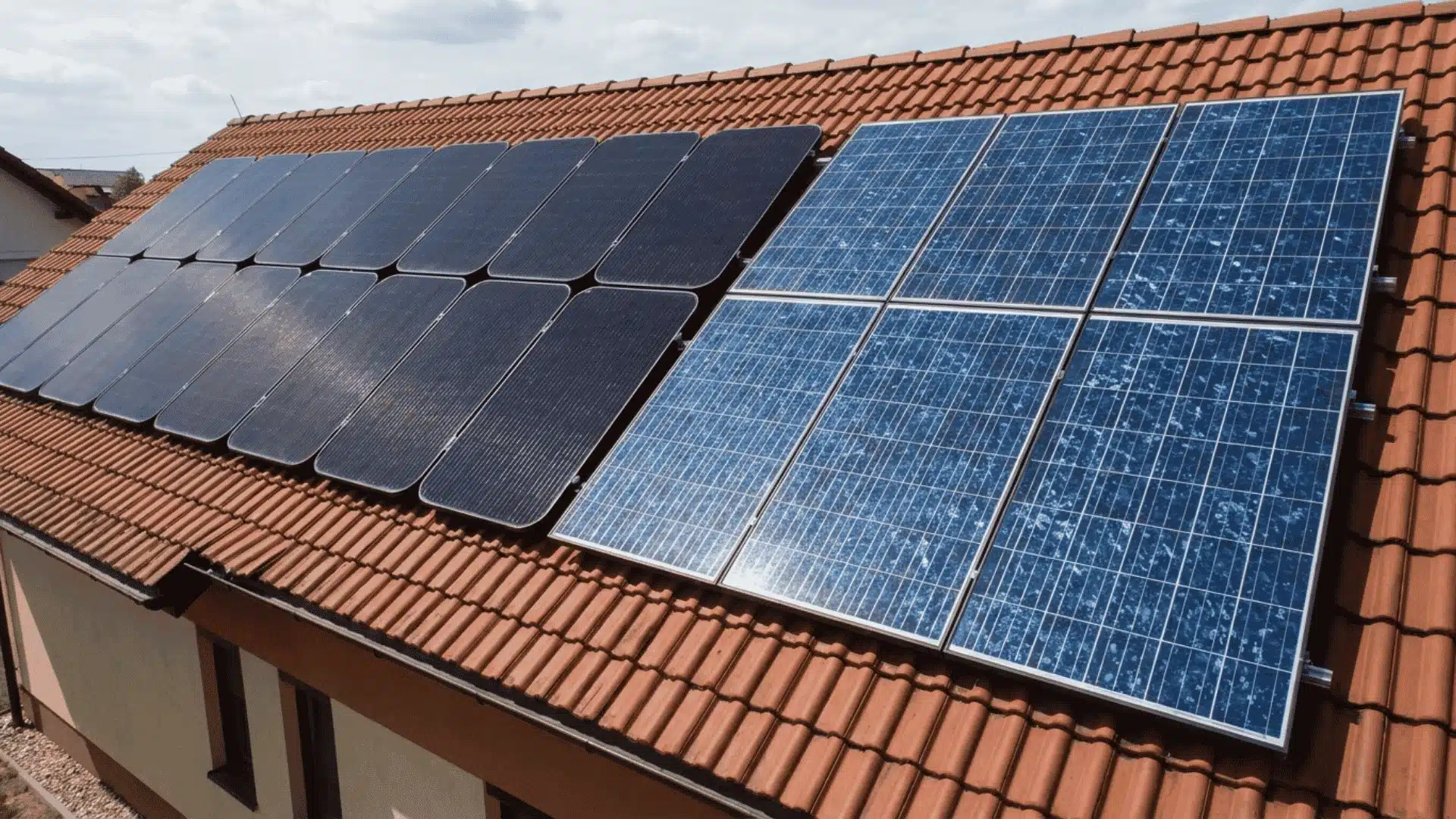
| Appearance | Uniform black or dark charcoal | Blue with a fragmented pattern |
| Roof space required | Less | More |
| Heat-related power loss | Usually lower | Usually higher |
| Manufacturing process | More complex | Simpler |
| Best suited for | Limited roofs and warmer climates | Large roofs and tighter budgets |
These differences provide a starting point, but roof conditions and installation costs still determine which panel offers better.
How the Two Solar Panel Types Are Made
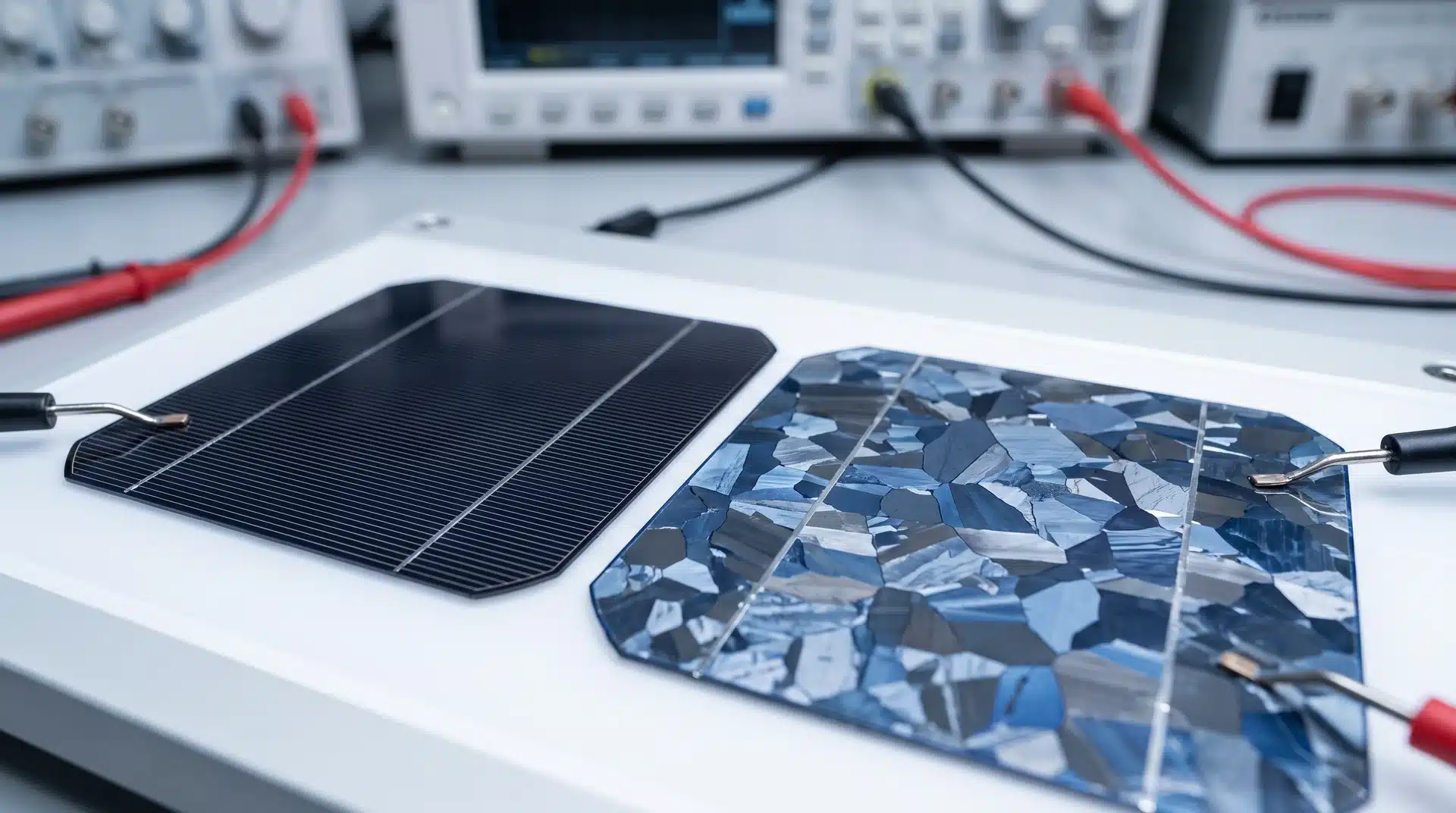
Both panel types use silicon, but their manufacturing processes create different internal cell structures. Among the main solar panel categories used for residential systems, monocrystalline and polycrystalline panels both rely on silicon. However, different manufacturing methods create distinct internal cell structures.
Monocrystalline Solar Cells
Manufacturers make monocrystalline cells by placing a seed crystal into melted silicon. The seed is slowly pulled upward, forming a single cylindrical silicon ingot.
The ingot is sliced into thin wafers that are used to create solar cells. Because every wafer has a consistent crystal structure, electrons can travel through it with fewer interruptions.
The process can produce more material waste because the round ingot must be trimmed so the cells can fit efficiently inside a rectangular panel. This historically made monocrystalline panels more expensive to manufacture.
Polycrystalline Solar Cells
Polycrystalline cells are produced by pouring melted silicon into a square mold and allowing it to cool.
Several crystals form during the cooling process and grow in different directions. The places where these crystals meet are known as grain boundaries.
These boundaries restrict electron movement and slightly reduce efficiency. However, the square molding process uses silicon more efficiently and traditionally helped manufacturers keep production costs lower.
How Panel Efficiency Affects Power Output
Solar panel efficiency measures how much available sunlight a panel converts into usable electricity.
Monocrystalline panels generally have higher efficiency ratings because their single-crystal structure allows electrons to move more freely. Polycrystalline cells experience greater resistance at the boundaries between crystals.
The efficiency difference matters most when usable roof space is limited. A higher-efficiency panel can generate more power from the same area, allowing an installer to reach the required system capacity with fewer panels.
For a large, unobstructed roof or ground-mounted system, lower efficiency may be less important because additional panels can be installed without creating major space limitations.
Rated Efficiency vs. Real-World Performance
Manufacturers test panels under Standard Test Conditions. These laboratory conditions include controlled sunlight and a cell temperature of 25°C.
Residential roofs do not remain under those conditions throughout the day. Temperature, clouds, wind, dirt, shading, and panel orientation continually affect electricity production.
| Factor | Laboratory Testing | Typical Roof Conditions |
| Cell temperature | 25°C | Often much higher on warm days |
| Sunlight | Controlled | Changes throughout the day |
| Shading | None | May come from trees, vents, or buildings |
| Panel surface | Clean | Dust and debris can collect |
| Wind | Controlled | Varies by location |
| Output | Used to calculate rated power | Changes with weather and site conditions |
Efficiency ratings are useful for comparing products, but they do not show exactly how much electricity a panel will generate on a particular roof.
Temperature Coefficient and Hot-Weather Output

Solar panels lose some power as their cell temperature rises. The temperature coefficient shows how much output is lost for every degree above 25°C.
Monocrystalline panels commonly lose approximately 0.3% to 0.4% per degree Celsius. Polycrystalline panels may lose around 0.4% to 0.5% per degree Celsius.
For example, a monocrystalline panel with a coefficient of –0.35% may lose about 3.5% of its rated output when the cell temperature reaches 35°C. A polycrystalline panel with a coefficient of –0.45% may lose about 4.5%.
The difference during one hour may appear small, but repeated heat losses can affect annual production in warm climates. Homeowners in hotter regions should therefore compare temperature coefficients rather than relying only on rated efficiency.
Polycrystalline vs Monocrystalline Solar Panels Cost
Panel price alone does not show the true cost difference. Homeowners should compare panel count, installation materials, labor, and total system capacity.
| Cost Factor | Monocrystalline Panels | Polycrystalline Panels |
|---|---|---|
| Panel price | Usually slightly higher | Traditionally lower |
| Panel count | Fewer panels may be needed | More panels may be required |
| Roof or ground space | Uses less installation space | Requires more installation space |
| Racking and mounting | May need less hardware | May need additional hardware |
| Wiring and connections | Fewer electrical connections | More connections may be needed |
| Installation labor | A smaller array may reduce labor | A larger array may increase labor |
| Total system value | Higher efficiency can offset the price | Savings depend on the complete quote |
The final quote should include panels, inverters, racking, wiring, permits, labor, roof work, monitoring equipment, and financing charges before comparing overall value.
Other Factors That Affect Panel Choice
Roof layout, panel appearance, and shade conditions can influence the final choice even when efficiency and cost appear similar on paper.
- Roof space and installation: Monocrystalline panels generate more electricity per square foot, making them suitable for small, irregular, or obstructed roofs. Polycrystalline panels may work well on large roofs or ground-mounted systems where additional panel space is available.
- Panel appearance: Monocrystalline panels usually have a uniform black or dark charcoal finish, while polycrystalline panels appear blue with a fragmented crystal pattern. Local building codes or homeowners association rules may also restrict panel color, placement, or visibility.
- Shading and system design: Both panel types lose output under shade. String inverters may allow one shaded panel to reduce the output of others, while microinverters and power optimizers manage each panel separately and limit wider losses.
These factors should be reviewed during the site assessment because panel type alone cannot solve limited space, visual restrictions, or uneven sunlight.
Monocrystalline or Polycrystalline Panels: Which Is Better?
Monocrystalline panels are usually the better option when roof space is limited, temperatures are high, or the system must generate more electricity from fewer panels.
Polycrystalline panels may still be appropriate when there is plenty of installation space and the lower purchase price creates a genuine saving after labor and equipment are included.
| Property Condition | More Suitable Option |
| Small or irregular roof | Monocrystalline |
| High electricity target | Monocrystalline |
| Hot climate | Monocrystalline |
| Uniform dark appearance preferred | Monocrystalline |
| Large unobstructed roof | Either type |
| Ground-mounted system with ample land | Either type |
| Strict upfront budget | Compare complete system quotes |
| Frequent partial shading | Focus on inverter design |
For many homes, monocrystalline panels provide the stronger overall balance of efficiency, space use, and heat performance. Polycrystalline panels should be considered when their lower price remains meaningful after the complete system has been designed.
Summing Up
The right solar panel is not simply the one with the highest efficiency or the lowest purchase price. I would compare how each option performs on your roof, in your climate, and within your total installation budget.
The difference between monocrystalline and polycrystalline solar panels becomes clearer when you consider silicon structure, heat performance, available space, panel count, appearance, and inverter design together.
Monocrystalline panels usually suit smaller or hotter roofs, while polycrystalline panels may still work where space is plentiful and savings remain meaningful.
Ask installers for complete system quotes, temperature coefficients, warranties, and panel datasheets before deciding. Compare those details carefully, then share which panel type best fits your property.
Frequently Asked Questions
Can you mix monocrystalline and polycrystalline panels on the same roof?
Technically, yes, but it is not recommended. Panels with different efficiency ratings, voltage outputs, and temperature coefficients cannot be connected in the same string without losses. If mixed, they must run on separate circuits with separate inverters or microinverters. Most installers will advise against it for a new installation.
How can you tell monocrystalline and polycrystalline panels apart by looking at them?
Monocrystalline panels have a solid, uniform black or dark charcoal appearance with slightly rounded cell corners. Polycrystalline panels are visibly blue with a fragmented, crystalline pattern across the cell surface and sharp square corners. The color difference comes directly from the difference in silicon crystal structure.
Do monocrystalline panels perform better in low light?
Monocrystalline panels have a slight edge in low-light conditions due to their more uniform crystal structure, but the difference is marginal. Both types produce substantially less power in overcast conditions or at dawn/dusk. Low-light performance is more significantly affected by panel brand, cell quality, and inverter type than by crystal structure alone.
Are polycrystalline panels becoming obsolete?
They are not obsolete, but their market share has declined sharply as monocrystalline production costs have fallen. Most major manufacturers have shifted capacity toward monocrystalline and next-generation variants such as PERC and TOPCon. Polycrystalline panels are still manufactured and sold, but fewer residential product lines are being developed around them.