




Selling power back to the grid sounds straightforward. Panels produce more than you use, surplus flows out, and credits return on your next bill.
But people find out only after signing that the credit rate is half the equation. Two plans with identical buyback rates can produce very different annual bills depending on how credits expire, how retail costs are structured, and what caps apply to exported energy.
Those structural differences buried in plan terms matter more than the headline rate. A higher buyback number tied to monthly expiring credits can underperform a lower rate that carries credits forward across billing cycles.
Before choosing a solar buyback plan in Texas, understanding what sits beneath the advertised rate is what separates a plan that performs from one that disappoints.
How Solar Buyback Plans Actually Work in Texas
In Texas, retailers set solar buyback credit rates independently, not utilities or the state. Unlike traditional solar net metering, no standardized credit structure exists across providers, which is why plan selection carries real financial weight.
Your buyback rate and retail rate operate independently of each other. A plan offering high buyback credits while charging high retail rates can quietly cancel out the savings you expected from exporting excess generation.
Credit rollover policy is where most plans diverge in ways the headline rate never reveals. Monthly plans reset unused credits at the end of each cycle, while annual plans carry surplus forward, letting summer exports offset winter consumption across the full year.
That rollover distinction directly determines how much your system’s seasonal production pattern translates into actual bill reduction, making it one of the most consequential terms to confirm before signing.
The Four Plan Structures You’ll Actually Choose Between
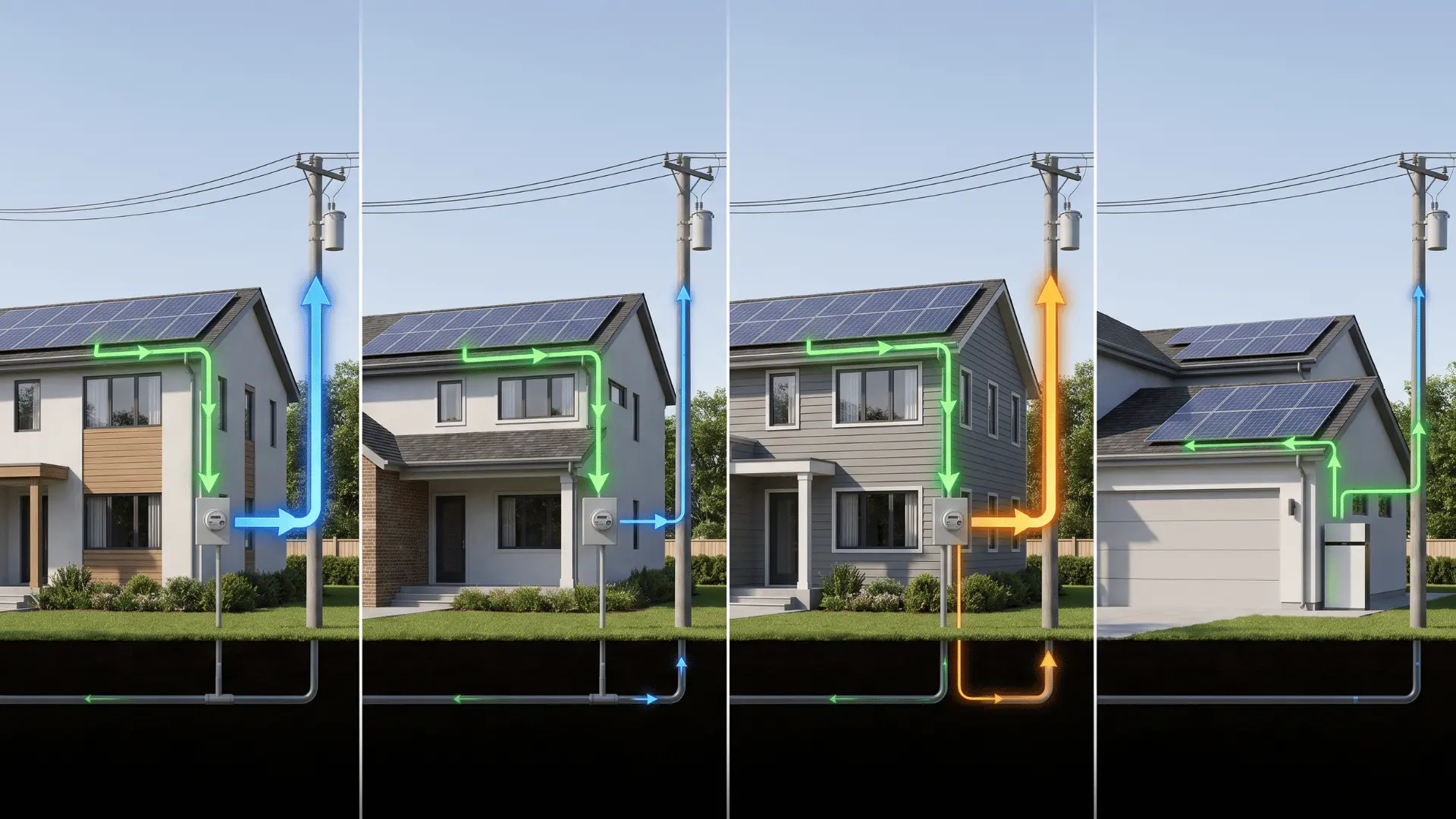
There are four main solar buyback plan structures in Texas. They differ in how exported electricity is credited, and that difference has a direct impact on your annual savings.
- 1:1 Retail-Rate Buyback: Every kilowatt-hour you export is credited at the same rate you pay for electricity. It sounds like the best option, but these plans often come with higher retail electricity rates, so compare the total bill, not just the buyback ratio.
- Sub-Retail Flat-Rate Buyback: Your exported electricity is credited at a fixed rate below the retail price you pay for grid power. The structure is simple and predictable, but you’ll always earn less for exported energy than you pay when buying electricity.
- Time-of-Use Buyback: The credit rate changes depending on when you export electricity. Power sent to the grid during peak demand hours earns more, while exports during off-peak periods receive lower credits.
- Bill-Credit-Only Plans: Credits are applied directly to reduce your monthly bill rather than creating a separate credit balance or cash payout. They’re straightforward to understand, but offer the least flexibility for households that regularly generate surplus energy.
The right plan depends less on the advertised buyback rate and more on how its structure matches the way your solar system produces and your household uses electricity.
What “1:1 Buyback” Actually Means on Your Bill
A 1:1 plan credits each exported kilowatt-hour at the same rate you pay to import one. The ratio holds, but the retail rate on these plans is often set higher than comparable non-solar plans, which means the underlying number doing the math is inflated from the start.
Your net annual bill can end up higher on a 1:1 plan than on a sub-retail plan with a lower base rate. The parity looks clean. The arithmetic does not always agree.
The structure that performs best depends on when your system exports, not only how much.
Whether any plan translates into meaningful savings also depends on usage pattern, utility type, and overall system economics, which is why most homeowners work through whether solar panels are even worth it in Texas before deciding on a provider.
The content is accurate and the table works well here. The main issue is the opening reads like a directory introduction and the section before the table feels thin. The note about tiered rates at the end is the most valuable point in the section and is currently buried. Here is a cleaner version:
Current Texas Providers and Where Each Plan Fits
The main providers offering solar buyback plans in Texas are TXU Energy, Chariot Energy, Green Mountain Energy, and Gexa Energy. Availability depends on which utility owns the transmission infrastructure in your area, not which retail provider you prefer.
Plans Available in Oncor Territory vs. Other Texas Service Areas
Oncor covers Dallas-Fort Worth and a large portion of central Texas, and most major solar buyback providers operate primarily within that footprint. Here’s a breakdown:
| Provider | Buyback Structure | How Credits Work | Key Limitation | Best Fit |
|---|---|---|---|---|
| TXU Energy | Bill-credit plan | Credits offset monthly energy charges | Credits reset each billing cycle, no rollover | Lower-export or steady monthly usage households |
| Chariot Energy | Flat-rate buyback | Fixed per-kWh credit set at signup | No dynamic rate advantage during peak production | Consistent year-round solar output |
| Green Mountain Energy | Bill-credit plan (Renewable Rewards) | Monthly credits applied to charges | Monthly reset limits long-term surplus value | Users prioritizing renewable-focused providers |
| Gexa Energy | Time-of-use buyback (varies) | Export rates change by time window | Lower value outside peak export hours | Systems producing during weekday peak hours |
The Tiered Buyback Threshold Most Comparisons Miss
One term to verify across all plans is whether the advertised buyback rate applies to all exported energy or only to energy up to a monthly threshold.
Some plans pay the headline rate on the first 500 kWh exported per month and a materially lower rate on anything above that.
This cap rarely surfaces and is easy to miss in plan documents. For larger systems that regularly export above that threshold, it can be the single factor that changes which plan produces the better annual outcome.
What to Check Before You Sign Up

The retail rate, what you pay per kWh when you draw from the grid, has more impact on your annual bill than the buyback rate does for most households.
Three other things matter before you sign:
- Credit rollover policy. Does unused credit carry forward month to month, or does it reset? If it resets monthly, high-summer exports don’t help you in winter.
- Whether the buyback rate is fixed, some plans lock the rate for the contract term. Others can revise it. Know which one you’re signing.
- Tiered export thresholds. As covered in the previous section, confirm whether the advertised rate applies to all your exported kWh or only to the first tier.
Month-to-month plans are worth a separate note. They give you flexibility to switch if something better comes along. But they also give the provider flexibility to change your buyback rate with relatively short notice. A fixed-term contract protects the rate you agreed to.
Conclusion
Choosing the right solar buyback plan comes down to one shift in how you evaluate options: stop leading with the buyback rate and start with the full picture.
What you pay for grid power, how your credits roll over, and whether your rate is protected are details that quietly determine whether your solar investment earns what it should. Texas gives you real choices, but deregulation means no one is standardizing the terms in your favor.
Read the contract. Check both rates. Know your utility territory. The households that get the most from their panels aren’t necessarily on the highest buyback rate; they’re on the plan that fits how their system actually produces.
Ready to compare? Start with the providers listed above and run the numbers both ways.
Frequently Asked Questions
How do solar buyback plans work in Texas?
In Texas’s deregulated market, your electricity retailer sets a credit rate for excess solar energy you export to the grid. That credit offsets your bill. The buyback rate, credit rollover policy, and the retail rate you pay for grid power are all set by the plan, not the state, so the plan structure matters as much as the buyback rate itself.
What is a 1:1 solar buyback plan?
A 1:1 plan credits your exported solar energy at the same per-kWh rate you pay for grid electricity. In principle, one exported kWh cancels one consumed kWh. In practice, the retail rate for 1:1 plans is sometimes higher than that for standard plans, so the net annual bill isn’t always lower than a sub-retail buyback plan with a cheaper base rate.
Which Texas solar buyback plan pays the most?
No single plan pays the most for every household. The highest buyback rate doesn’t always produce the lowest annual bill; what matters is the combination of buyback rate, the retail rate charged for grid draw, and whether your credits roll over monthly or annually. Run both sides of the equation against your actual export and consumption data before making a choice.
Do solar buyback credits expire in Texas?
It depends on the plan. Some plans roll unused credits forward month to month within a contract year; others reset credits at each billing cycle. Households with high summer export and high winter consumption lose significant value on monthly-reset plans. Confirm the rollover policy before signing; it is rarely highlighted in plan marketing materials.