


Solar incentives aren’t one thing. They’re a set of programs from the federal government, your state, and your utility, and each one cuts your costs in a different way.
A tax credit reduces what you owe the IRS. A rebate pays cash no matter what your tax bill looks like. A billing program lowers what you pay each month. A tax exemption prevents new costs from appearing at all.
These four types work on their own, and they stack. Knowing which one you’re dealing with changes how you plan. Get clear on the mechanics before you talk to an installer, and you’ll know your real number instead of guessing at it.
What Are Solar Incentives?
If you’ve heard “solar incentive” and pictured a single discount, you’re not wrong to start there. But that picture isn’t detailed enough to be useful when you’re actually planning a purchase.
Solar incentivesare programs from three sources: the federal government, state governments, and your utility company. Each one cuts your cost in a different way. Once you understand the four types, stacking them becomes straightforward.
Here are the four types and what each one actually does:
- Tax credits reduce the income taxes you owe. They only pay off if you have a tax bill to apply them against.
- Rebates cut your upfront installation cost with a direct cash payment; your tax situation has nothing to do with it.
- Billing programs like net metering lower your monthly utility bill based on what your system sends back to the grid.
- Tax exemptions stop new costs from appearing; they keep your property taxes or sales tax from going up just because you added solar.
Each type is separate. No single program offers 30% off on its own. That number only shows up when multiple types work together.
Note: Residential Clean Energy Credit applies to homeowners who own their system. Investment Tax Credit (Section 48E) applies to businesses or third-party-owned solar installations.
If you lease your panels or sign a Power Purchase Agreement (PPA), your installer claims the federal credit, not you. The credit goes to whoever owns the equipment.
How Does the Federal Solar Tax Credit Work?
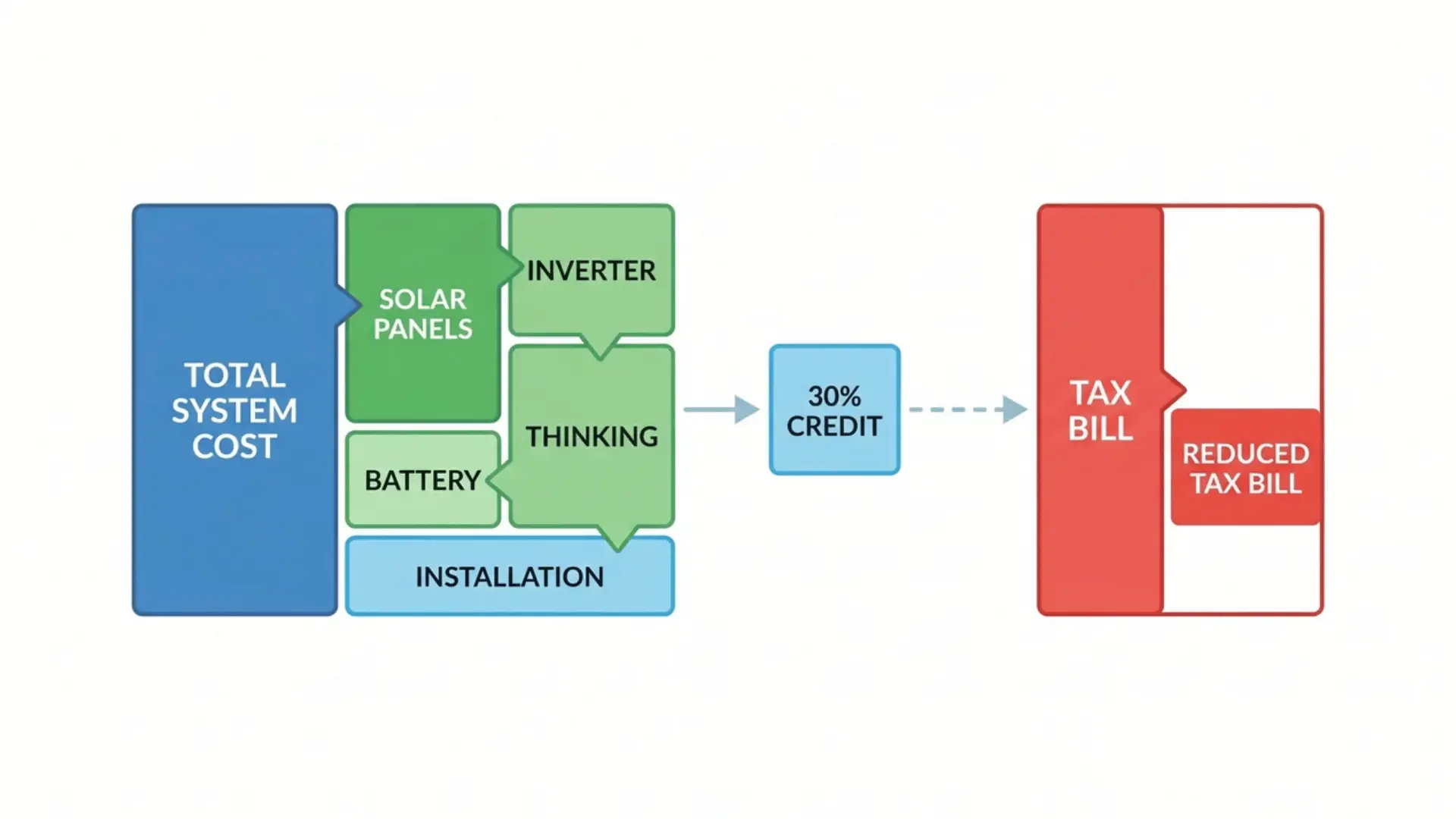
The federal credit is the biggest solar incentive most homeowners will ever access. I’ve also seen it misunderstood more than any other program, usually in the same two ways. People think it works like a discount at checkout, and they don’t know which costs actually count toward it.
Here’s how it actually works.
Who Qualifies?
The Residential Clean Energy Credit knocks dollars directly off your federal income tax bill after you install. It’s not applied at checkout. It shows up when you file your taxes.
You need to meet four conditions to claim it. All four matter:
- You own the system. Leased panels don’t qualify. On leased or PPA systems, the installer takes the credit; that’s one of the real costs of not owning your equipment.
- You have federal tax liability. If you don’t owe taxes, there’s nothing to reduce.
- The system is on a primary or secondary U.S. home. Investment properties are out.
- Installation wraps up in the tax year you’re claiming. The credit applies to the year the system goes live.
If your tax bill is less than the full credit, the remaining amount carries forward to next year. That’s a detail worth knowing before you build your whole financial plan around this credit.
What Costs Count Toward the 30%?
The 30% applies to your full qualifying system cost, not just the panels. Here’s what goes into that number:
- Solar panels and mounting hardware
- Inverters and electrical components
- Battery storage systems installed alongside the solar array
- Labor costs for installation and inspection
- Permitting and developer fees are tied directly to the system
Thirty percent of that total comes off your tax bill. That’s why two homes with the same panel count can end up with different credit amounts: one includes battery storage, the other doesn’t.
Here’s one I’ve seen catch people off guard: if your utility gave you a subsidy toward the installation, that amount gets subtracted from your cost basis before the 30% is calculated. The IRS requires it. Many installers don’t bring it up.
Is the 30% Credit Still Available?
The Residential Clean Energy Credit remains at 30% in 2026. It applies to qualifying home solar installations and eligible clean energy systems.
Concerns about it ending come from ongoing policy discussions. No official change has reduced or removed the credit rate for current installations so far.
Before making decisions, always verify the latest IRS guidance or consult a tax professional. Incentives can change, so confirm eligibility for your specific filing year.
What State and Utility Incentives Can You Stack on Top?
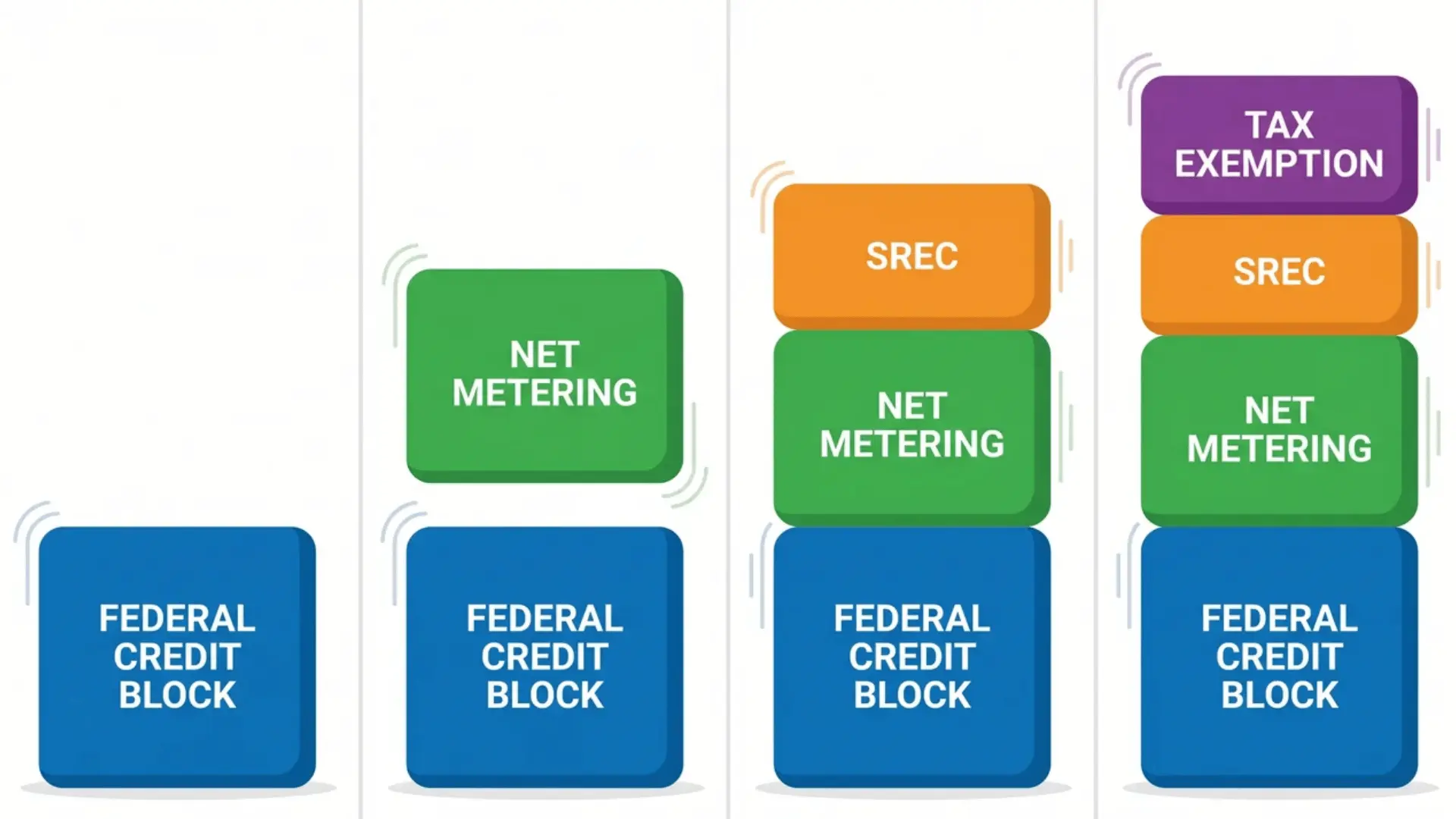
The federal credit is a starting point, not a finish line. State and utility programs add more savings on top, each through its own path, each with its own rules. I’ve watched homeowners walk away from real money by stopping at the federal level and never digging further.
Here’s what each layer does and where it can break down:
1. State Tax Credits
Several states run their own income tax credits that stack directly on top of the federal one. Arizona, Massachusetts, New Mexico, New York, and South Carolina all have specific programs.
They work the same way the federal credit does: dollar for dollar off your state income tax bill. State programs change more often than federal ones, so confirm what’s active for your filing year before you count on any specific credit being there.
2. Net Metering
Net metering is often misunderstood during solar planning. It affects system sizing, making it important to understand before deciding how much solar capacity to install.
It is a billing system, not direct power selling. Excess solar sent to the grid earns credits, while your meter tracks energy flow in both directions.
Credit rates vary by utility and can change over time. Some states have reduced benefits, so always check the current local policy before sizing your system.
3. SRECs and State Rebate Programs
SRECs are not rebates or bill credits. They represent solar energy generation measured in megawatt-hours and tracked as tradable certificates tied to your system output.
You earn one certificate per megawatt-hour produced. These certificates are sold in energy markets, where utilities buy them to meet renewable energy requirements.
Not all states offer SRECs. Where available, prices vary with demand, and programs differ by state, including trading platforms, performance payments, or fixed rebates.
Check current SREC prices in your state before you build them into your payback estimate. That market moves.
4. Property and Sales Tax Exemptions
Property tax exemptions and sales tax exemptions don’t put cash in your pocket or shrink your tax bill directly. What they do is stop going solar from raising your other bills.
Most states with property tax exemptions leave the added home value from your solar system out of your taxable assessed value. Your property taxes stay flat even as your resale value climbs.
Sales tax exemptions pull the state sales tax off the equipment purchase entirely. It’s a quieter saving, but on a large system it’s real money, and it’s worth confirming before you buy.
How Do You Find out Which Solar Incentives Apply to You?
Knowing the types is a good start. Knowing what’s live in your ZIP code, for your utility, with your tax picture- that’s what you actually need before making any decisions. Two steps get you there.
Start with DSIRE.
The Database of State Incentives for Renewables and Efficiency at dsireusa.org tracks every active federal, state, and utility incentive program in the country. Enter your ZIP code, and you’ll see what’s running in your area right now. It’s free, it’s publicly maintained, and it’s the most reliable place to start.
DSIRE is good at policy-level programs. But some utility rebates live only on the utility’s own website. Cross-check both sources; it takes ten minutes and closes the gap.
Check your tax situation before you size the system.
The federal credit only helps you if you have federal tax liability. Pull your last tax return and look at what you actually owed. If that number is low, the credit will carry forward, but that changes your financial timeline. Know the number before you sign anything.
Do both of these before you get installer quotes. Installers’ price is what you expect to pay. Walk in knowing your incentive stack, and you’re negotiating from a much stronger spot.
Wrapping Up
Tax credits, rebates, billing programs, and tax exemptions each work on their own and stack with each other. That’s what makes the total savings real. No single program carries you there alone.
The federal Residential Clean Energy Credit is the biggest lever for most homeowners. But what piles on top of it depends on your state, your utility, and your tax situation.
That’s the part worth spending time on. Once you know your actual stack, you walk into every installer conversation with your real number in hand. That’s not a small thing, it changes the whole dynamic of the conversation.
Frequently Asked Questions
Is the 30% federal solar tax credit still available in 2026?
As of early 2026, the Residential Clean Energy Credit is still at 30% for homeowner-installed systems. Congressional debate about its future is ongoing, and some changes have already passed in recent sessions. Check the IRS website or talk to a tax professional before you make installation or financing decisions based on the current rate.
What happens if you don’t owe enough taxes to use the full solar credit?
You don’t lose it. The unused portion carries forward to the next tax year and keeps rolling until it’s fully used. If your income varies year to year or you’re retired, plan for the credit to take longer to absorb than most installers will tell you.
What is the difference between a solar tax credit and a solar rebate?
A tax credit cuts what you owe the federal or state government in income taxes, it only works if you have a tax bill to reduce. A rebate is a direct cash payment from a utility or program that lowers your upfront installation cost, no matter what your tax situation looks like. Both can apply to the same installation.
What is DSIRE and how do I use it?
DSIRE is the Database of State Incentives for Renewables and Efficiency. It’s a free, publicly maintained tool that tracks solar and clean energy programs across the country. Go to dsireusa.org, enter your ZIP code, and you’ll see every active federal, state, and utility incentive in your area. It’s the best first stop for figuring out what applies to you.