

When people compare solar panels, efficiency is usually the first number they notice. I used to think a higher percentage automatically meant a better solar panel, but that number only explains one part of the system’s performance.
The confusion comes from treating efficiency, power output, and overall panel quality as the same thing. They are connected, but they answer different questions about how a solar cell performs.
Understanding solar cell efficiency helps explain why most residential panels fall within a similar range, why laboratory cells achieve much higher results, and why real-world electricity production can differ from the number shown on a specification sheet.
What Is Solar Cell Efficiency?
Solar cell efficiency is the ratio of electrical energy produced by a solar cell to the sunlight energy that reaches its surface. This measurement is taken under Standard Test Conditions (STC), which provide a consistent environment for comparing different solar technologies.
In practical terms, a solar cell rated at 20% efficiency converts roughly one-fifth of the sunlight reaching its surface into electrical power under those controlled test conditions.
Most consumer solar panels today operate around 20–24% efficiency. When I first saw these numbers, they seemed lower than expected, but this range is normal for mass-produced residential solar technology rather than a sign of poor performance.
Laboratory solar cells have exceeded 47% efficiency, but those results come from advanced designs and controlled testing environments. They are not directly comparable with standard rooftop panels because they use different materials and development methods.
What Determines Solar Cell Efficiency
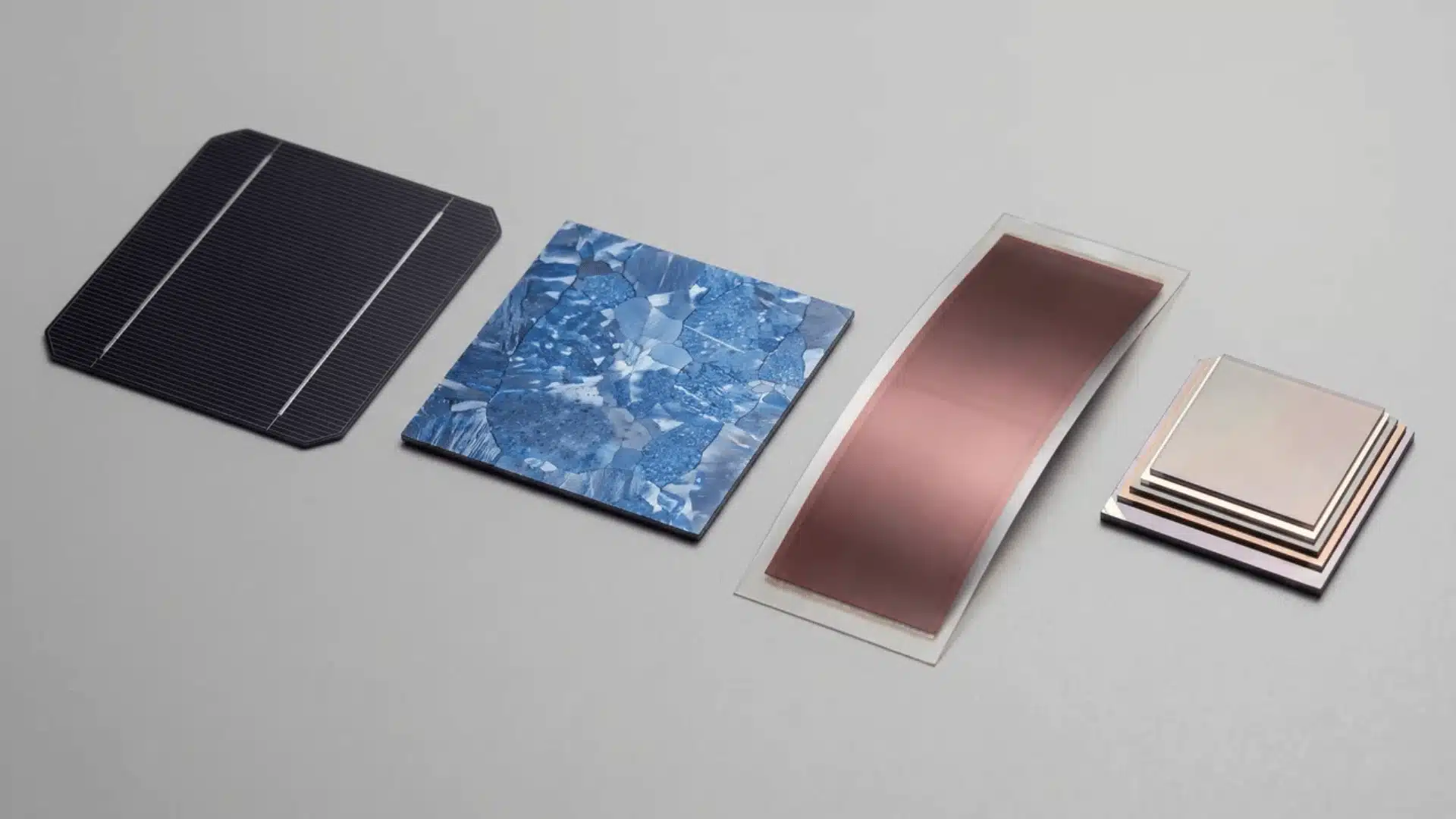
Material choice and cell design create most of the difference in solar cell efficiency. Manufacturing quality matters, but the biggest factor is how effectively a material can capture sunlight and convert it into electrical energy.
Different photovoltaic materials interact with sunlight in different ways. Some capture more usable energy from the light spectrum, while others lose more energy as heat or unused radiation.
Efficiency by Cell Type
| Technology | Typical Efficiency | What Drives the Number | Where It’s Used |
|---|---|---|---|
| Monocrystalline (standard) | 20–24% | Single-crystal silicon gives electrons a uniform path with fewer barriers | Most residential rooftops |
| TOPCon (Tunnel Oxide Passivated Contact) | 24–25% | Thin oxide layer reduces energy lost when electrons recombine at the cell surface | Premium residential panels |
| HJT (Heterojunction Technology) | 24–26% | Amorphous silicon layers on both surfaces cut recombination losses; holds efficiency better in heat | Premium residential panels |
| Polycrystalline | 15–17% | Multiple crystal boundaries increase recombination, limiting how much light converts | Largely replaced in residential use |
| Thin-film | 10–18% | Very thin photovoltaic layers reduce output per area but allow lightweight, flexible formats | Commercial and utility-scale projects |
| Perovskite tandem | Lab stage | Stacked materials capture more of the sunlight spectrum than any single-junction design can | Not yet commercially available |
Why There’s a Ceiling on Silicon
Single-junction silicon cells have a physical efficiency limit because they can only convert a limited portion of sunlight into electricity.
Sunlight contains many different wavelengths of energy. Silicon can absorb some of them effectively, but some light passes through while other energy is lost as heat. This creates a theoretical limit known as the Shockley-Queisser limit, which places the maximum efficiency of a single-junction silicon cell at around 29%.
This limit explains why improving silicon manufacturing alone cannot increase efficiency forever. The challenge is not only making better cells, but finding ways to capture more of the sunlight spectrum.
Perovskite tandem cells approach this problem by combining materials with different absorption ranges. One layer can capture energy that silicon cannot use efficiently, allowing more sunlight energy to be converted into electricity.
What Solar Cell Efficiency Is Not
The efficiency percentage is one number, but it is doing less work than most people assume.
Efficiency Is Not the Same as Power Output
A higher efficiency percentage does not automatically mean a panel will produce more electricity than one with a lower rating. Efficiency describes how effectively a cell converts sunlight within a given area; total power output depends on both efficiency and panel size together.
A larger panel with lower efficiency can produce more electricity than a smaller, highly efficient panel because it has more surface area collecting sunlight. The efficiency number describes conversion ability under specific test conditions, not total electricity generated.
Efficiency is also a cell-level measurement. How much of that converted electricity actually reaches usable form depends on the complete PV system, not the cell alone
Efficiency is also a cell-level measurement. The complete PV system, including panels, inverters, wiring, and optional battery storage, determines how much of that converted electricity actually reaches usable form.
Cell Efficiency Is Not Module Efficiency
The efficiency number on a panel’s specification sheet is the module efficiency, which is always lower than the efficiency of the individual cells inside.
The gap comes from parts of the module that do not generate electricity: gaps between cells, the aluminum frame border, the protective glass and encapsulant layer, and the metal ribbons that connect cells together.
None of these contribute to output, but all occupy area within the panel’s footprint, reducing the assembled module’s overall efficiency by roughly two to three percentage points compared with the cells themselves.
A panel built with cells rated at 24% efficiency will typically show a module efficiency of around 21–22% on its specification sheet. The cell efficiency describes what the material can do; the module efficiency describes what the finished product delivers
Why Solar Cell Efficiency Matters When Choosing Panels
Efficiency is a space-per-watt measurement, not a universal quality score. How much it matters depends on your roof.
| Efficiency matters more when… | Efficiency matters less when… |
|---|---|
| Roof space is limited or broken up by dormers, vents, or skylights | You have ample, unshaded roof area to work with |
| You need maximum output from a fixed footprint | Adding one or two extra panels would close the same gap at lower cost |
| Obstructions reduce the number of panels you can fit | System orientation and design will have more impact on output than panel specs |
| You want to leave room for future expansion | Budget is better applied elsewhere in the system |
Wrapping Up
Learning about solar cell efficiency changed the way I looked at solar panels. The percentage is useful, but it does not tell the complete story of how a solar system performs.
The most helpful way to interpret efficiency is to understand what question the number answers. It explains conversion ability, while other factors determine how that ability translates into usable energy.
Once efficiency is viewed in the right context, comparing solar technologies becomes much clearer. The highest percentage is not always the goal; the right balance depends on the space, design, and purpose of the system.
Frequently Asked Questions
What Is a Good Efficiency Rating for a Residential Solar Panel?
A good residential solar panel efficiency rating is usually between 20% and 24%, which represents the current standard for modern consumer panels. This range is considered efficient for home installations and should not be compared directly with laboratory-only cells above 47%.
Why Aren’t Solar Panels More Than 25% Efficient?
Most consumer panels use single-junction silicon, which can only convert a limited portion of sunlight’s spectrum. This creates a physical efficiency ceiling below roughly one-third. Designs like perovskite tandem cells aim to overcome this limit by combining materials with different absorption ranges.
Does Higher Efficiency Mean a Better Solar Panel?
Not necessarily. Higher efficiency means more electricity can be produced from a smaller area, which is useful when space is limited. If available space is not a concern, a lower-efficiency panel may still produce the required energy more practically.
Why Does My Panel’s Real Output Differ From Its Rated Efficiency?
Rated efficiency is measured under controlled Standard Test Conditions with stable temperature and clean sunlight exposure. Real installations experience heat, dust, shading, and inverter losses, which reduce actual electricity production compared with the listed efficiency rating.