



Your electric bill went up after switching to a mini split, and that’s not what you signed up for. Are mini splits efficient? The honest answer depends on two things working together, and most spec sheets never mention either one.
A mini split can carry an impressive rating and still leave you disappointed if it’s sized wrong or installed poorly. I’ve seen this trip up plenty of homeowners who did everything by the book.
By the end of this, you’ll know exactly what drives real efficiency, where it breaks down, and how to tell if your setup is actually working the way it should.
Are Mini Splits Efficient: What Actually Makes Them Work
Yes, mini splits are efficient, and it comes down to three things: no ductwork, an inverter compressor, and zoning.
The proof is in the SEER2 rating, the score for how much heating or cooling you get per unit of energy. Central air usually scores 14 to 16. Mini splits routinely hit 17 to 30.
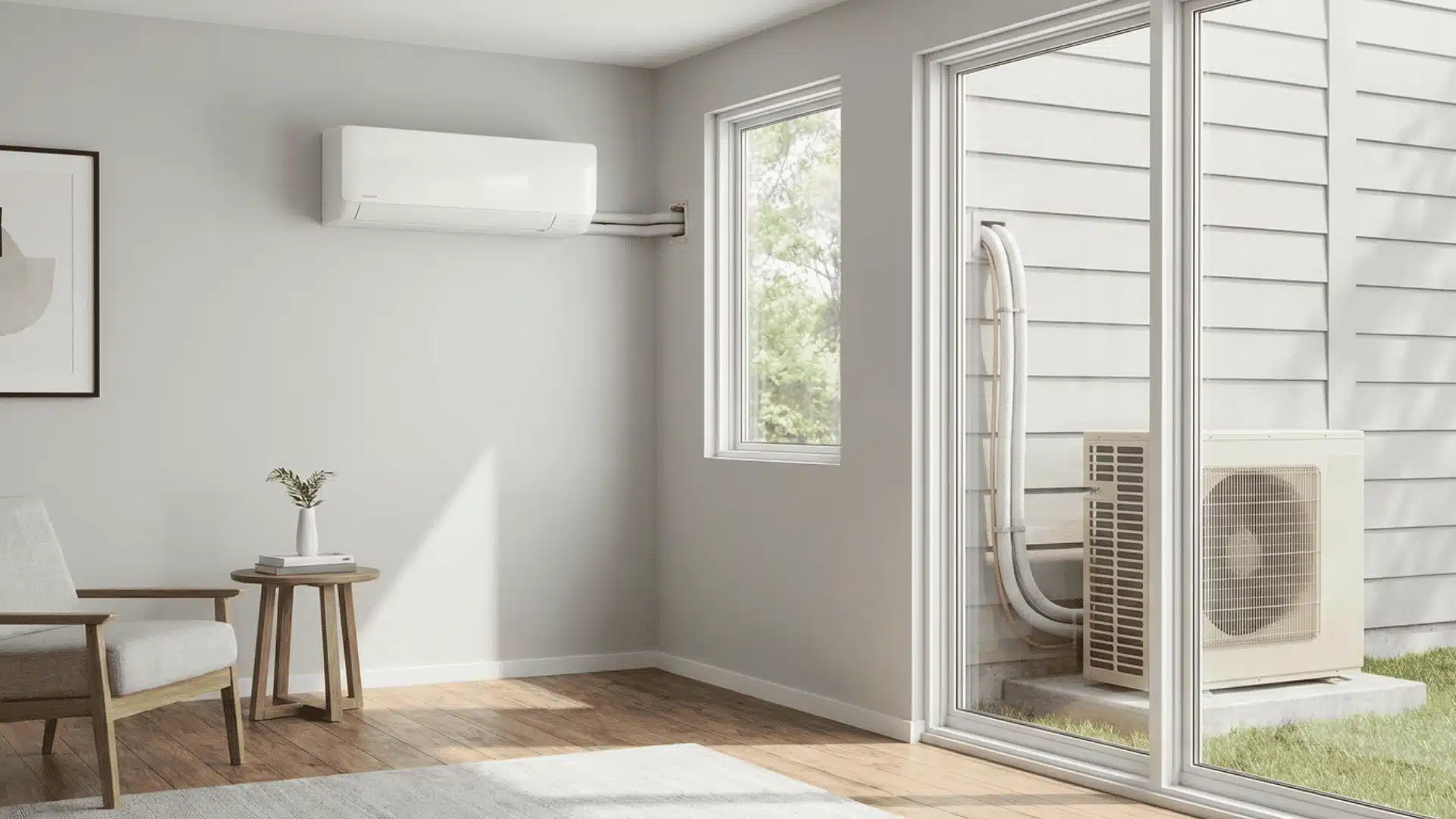
No ductwork. Central air loses energy through ducts, especially in poorly sealed attics. A mini split’s unit sits right in the room, so the air it makes is the air you get. This delivery difference is really what separates ducted from ductless systems in the first place, more than any equipment upgrade.
Inverter technology. Regular compressors blast on, then shut off completely, wasting energy on every restart. A mini split’s compressor runs constantly at a low, adjustable speed instead.
Zoning. Each indoor unit runs on its own, so you only condition rooms you’re actually using, not an empty guest room or closed-off basement.
That’s the real mechanics behind the numbers above, not just newer equipment.
Why Rated Efficiency and Real-World Efficiency Are Different Numbers
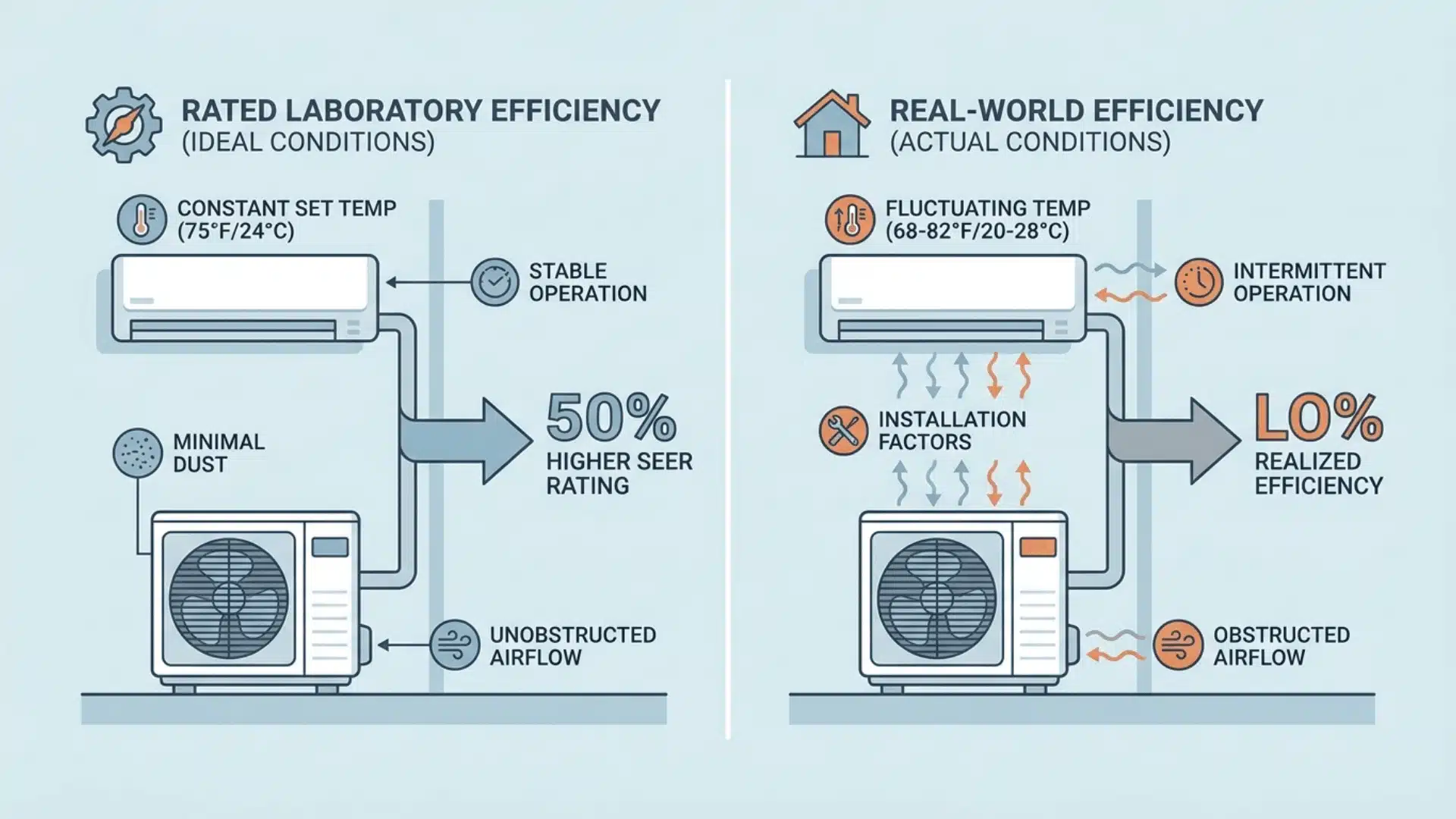
A high SEER rating is a ceiling, not a promise. Where your unit actually performs depends on how well it matches the load of the space it’s conditioning.
1. What SEER and COP Actually Measure
SEER measures cooling output per unit of electricity consumed, but under controlled lab conditions: stable outdoor temperature, consistent indoor load, fixed runtime. Real homes don’t work that way.
COP works the same way for heating. Neither rating accounts for temperature swings, uneven room loads, or how the system actually gets used day to day.
The rating tells you the best the unit can do under ideal conditions. It doesn’t tell you what it will do in yours.
2. The Conditions That Close the Gap Between Rated and Actual
Four variables determine where real performance lands:
- Outdoor temperature
- Indoor load
- Runtime pattern
- Installation quality
Temperature matters most. I’ve seen this firsthand: a mini split that feels highly efficient on mild days can perform differently in extreme heat or cold. In those conditions, efficiency naturally drops as the system works harder.
Installation quality also affects overall performance. A high-rated system can still struggle due to poor airflow, an undersized lineset, or incorrect heat loss assessments, regardless of its SEER rating.
3. Why Oversizing Is the Most Common Efficiency Killer
An oversized unit cools or heats the space too quickly. It hits setpoint, shuts off, and cycles back on when temperature drifts. That sounds fine, but it’s actually not.
Variable-speed inverter compressors are efficient because they modulate, running at 40% capacity for longer rather than blasting at 100% and then stopping. Oversizing eliminates that behavior entirely.
The result is a high-SEER unit behaving like a basic on/off system. You pay for the efficiency rating, but you don’t get it.
How Variable-Speed Operation Produces Efficiency That Spec Sheets Don’t Show
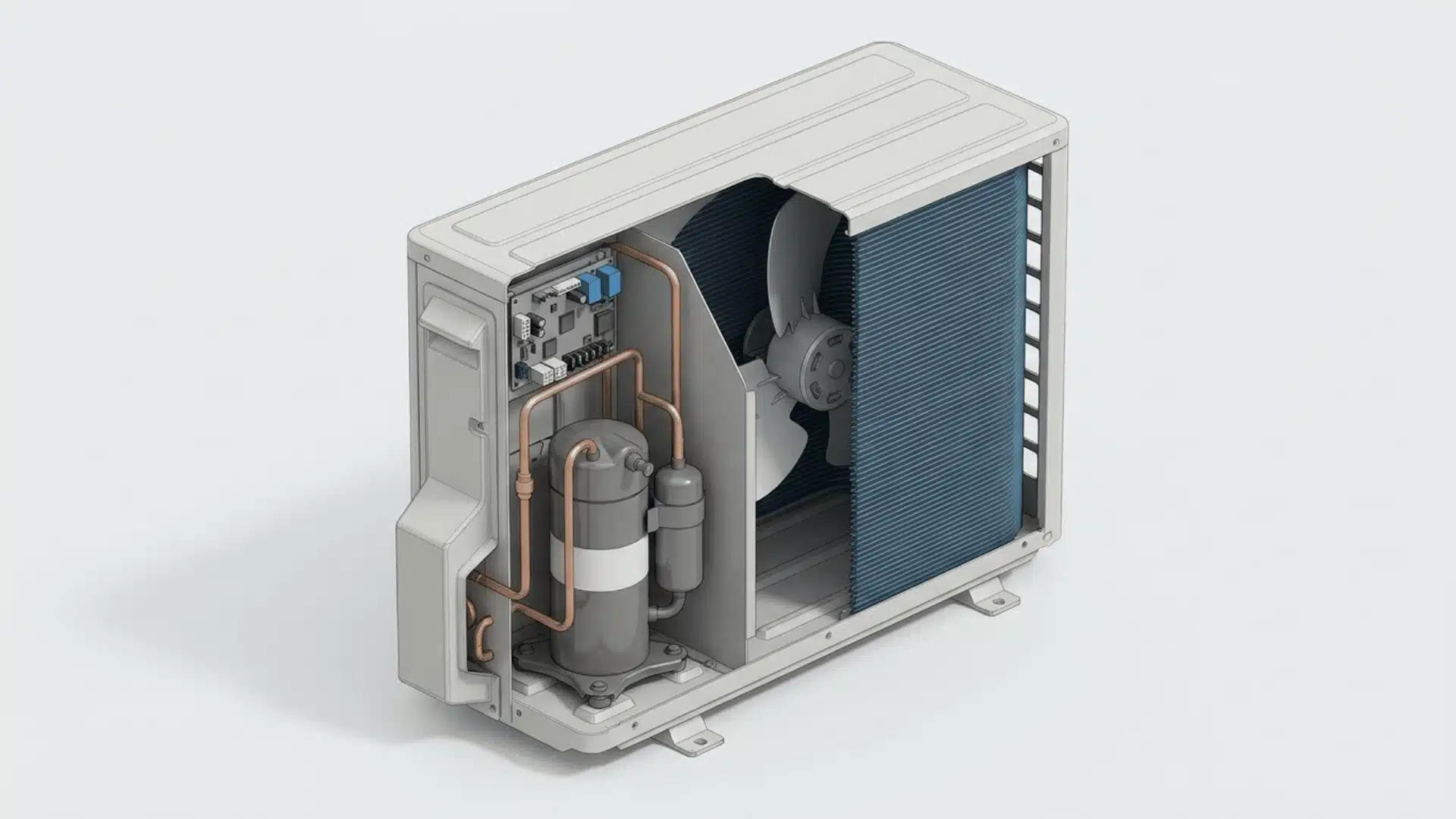
Inverter-driven variable-speed operation is what makes mini splits efficient in practice, not just on paper. Here’s how it actually works:
- Fixed vs. variable speed: A fixed-speed compressor runs at full power or shuts off. A variable-speed inverter modulates between 25% and 100% to match the room’s load.
- Startup current spikes: Every startup draws more current than during steady-state operation. Fixed-speed systems trigger that spike every cycle.
- Refrigerant pressure: Sustained part-load keeps the refrigerant circuit in a lower-pressure steady state, meaning less mechanical work per unit of heat moved.
- The BTU trap: A mini split at 40% for four hours uses less electricity than one at 100% for two hours, even when the total BTU delivery is identical.
- Where the loss hides: Startup spikes, higher pressure, and peak-load losses don’t show in BTU output. They show up on your electricity bill.
Modulation also improves comfort. The system runs continuously at low output instead of cycling on and off, so room temperature stays steadier between cycles.
The rating on the spec sheet assumes ideal conditions. What you actually consume depends on whether the system ever gets to modulate, and that comes down to sizing.
When Mini Splits Are Less Efficient Than They Appear, and Why
Mini-splits are efficient under the right conditions. Cold extremes and multi-zone load mismatch are the two situations most likely to close that gap.
| Condition | What Happens | What It Means for You |
|---|---|---|
| Cold-climate performance | COP drops below 20°F. Some models approach resistive parity near 0°F. | Winter bills may not match headline efficiency figures in cold climates. |
| Multi-zone load mismatch | A single outdoor unit runs at whatever load the most-demanding zone requires. Idle zones get conditioned inefficiently. | Claims that central air outperforms multi-head systems often trace back to this. |
| Maintenance degradation | Refrigerant loss, dirty air handlers, and blocked outdoor airflow each predictably reduce performance. | Unlike duct degradation, loss of mini-split efficiency is visible and reversible. |
The difference between mini-splits and ducted systems is that with a mini-split, you can usually find the cause when it underperforms. Fix it, and performance returns.
Sunmming Up
A high rating on paper only tells half the story. What actually happens in your home depends on sizing, installation, and how often your system gets to run the way it’s designed to.
Get those right, and a mini split delivers real savings, not just numbers printed on a box. Get them wrong, and even a great unit ends up cycling like a basic system.
So are mini splits efficient? They can be, but only under the right conditions, and those conditions are knowable before you install one. If you’re weighing a mini split for your own place, start with a proper load calculation.
Got questions or your own experience with one? Drop a comment below.
Frequently Asked Questions
Are mini-splits more efficient than central air?
In most residential applications, yes, primarily because they eliminate duct losses, which typically account for 20–30% of conditioned air in ducted systems, and because variable-speed compressors modulate to match load rather than cycling on and off. The gap narrows in well-sealed duct systems and widens in homes with older, leaky ductwork.
Why is my electric bill high with a mini-split?
The most common causes are incorrect sizing, an oversized unit cycling instead of modulating, losing the inverter efficiency advantage, and cold outdoor temperatures, where heat pump efficiency drops measurably. A unit running in resistance-heat backup mode at low temperatures can approach the same consumption as a standard electric heater.
How efficient are mini-splits in winter?
At moderate cold temperatures (25–45°F), most modern mini-splits maintain COP values between 2.0 and 3.0, meaning they deliver two to three times as much heat energy as they consume in electricity. Efficiency drops below 20°F; some systems include resistance-backup heating that activates at extreme cold, which significantly increases consumption.
What does SEER mean for mini-splits, and does a higher number always mean lower bills?
SEER (Seasonal Energy Efficiency Ratio) measures cooling output per unit of electricity input under standardized lab conditions. A higher SEER sets a ceiling for efficiency; real-world consumption depends on sizing accuracy, installation quality, outdoor temperatures, and how often the unit runs at full versus partial capacity.