


Solar comes up fast in Arizona conversations, especially when summer power bills climb. Most homeowners want straight answers on who to trust and why.
Not every installer operates the same way. Some lead on battery storage. Others earn their reputation through custom design or post-install support that genuinely holds up.
The right choice depends on your roof, your utility, and how you plan to pay. Those three factors narrow the field faster than any review platform will.
This guide breaks down the top Arizona installers, what each one does well, and how to match the right company to your specific situation.
What to Know Before You Pick an Installer
Most homeowners compare solar quotes on price alone. That approach misses the factors that actually determine whether an installation goes smoothly or becomes a post-install headache.
- Utility provider (APS vs SRP): APS and SRP bill differently, which affects how a system should be sized and designed.
- Installer model (in-house vs subcontracted): Whether the installer uses its own crew or outsources work becomes critical when repairs or adjustments are needed.
- Labor warranty coverage: Not just how long it runs, but what it actually includes and excludes over the system’s lifetime.
Getting clear on these three before reviewing any proposal makes the comparison process significantly more useful.
Top-Rated Solar Companies in Arizona
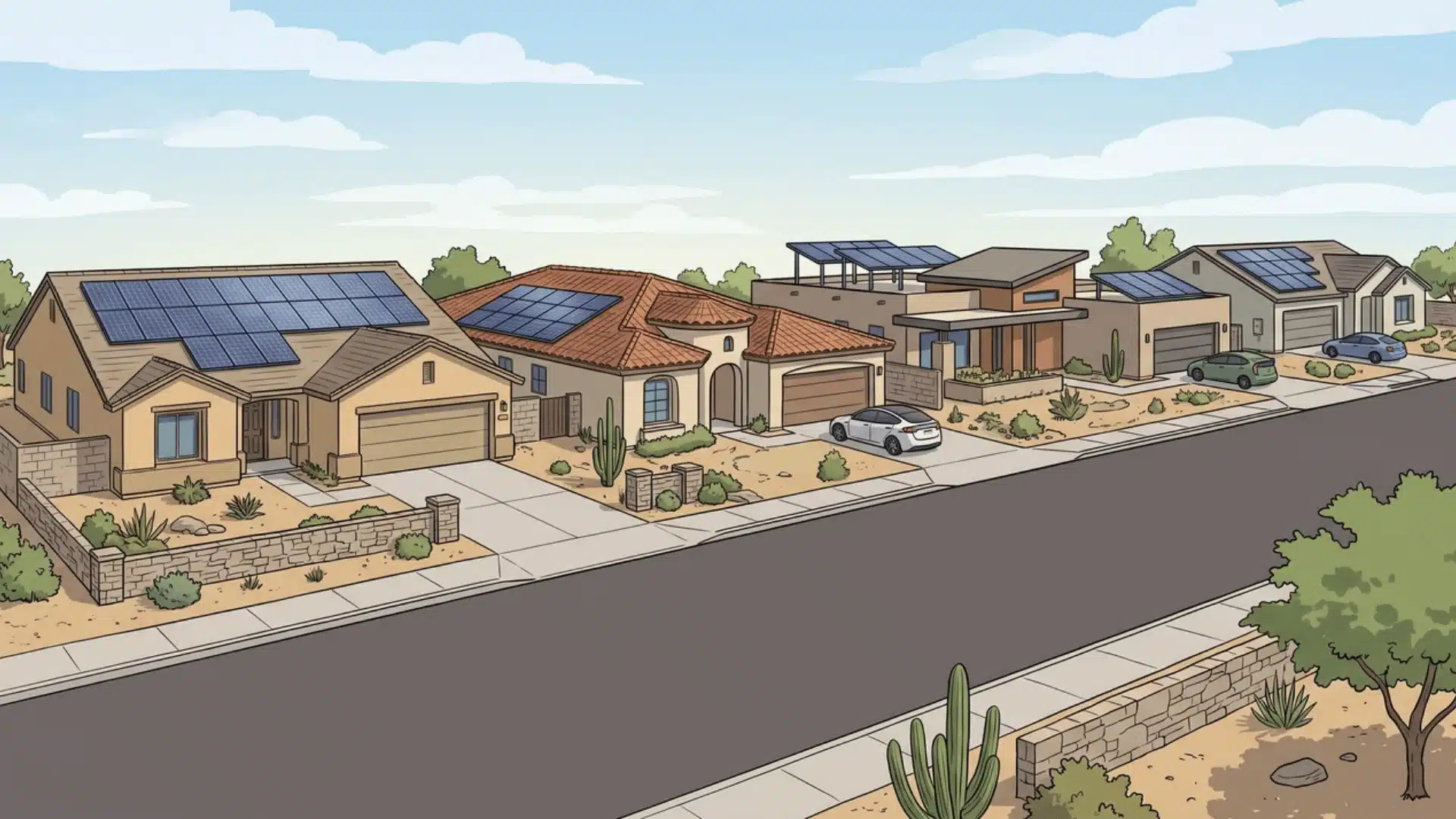
Not every company on this list is right for every homeowner. The right pick depends on your location, your utility, and what you need from the installation itself.
| Company | Best For | Stand Out Factor | Watch Out For |
|---|---|---|---|
| Solar Topps | Battery storage integration | Operating for seventeen years, deep APS and SRP policy experience | Not the fastest quote turnaround |
| Sun Valley Solar Solutions | Custom system design | Assesses roof orientation, shading, and actual usage before proposing | Slower process than template-based installers |
| Black Platinum Solar & Electric | Community-vetted installs | Consistent neighbor-to-neighbor recommendations over polished review profiles | Lower visibility on national platforms |
| Elevation Solar | Whole-home energy integration | Pairs solar with battery backup, smart thermostats, and efficiency upgrades | Higher upfront cost than panel-only installs |
| Envision Solar | High-volume reliability | One of the highest verified review counts in the Phoenix metro | Scale can strain post-install service if growth outpaces operations |
Here is how each company breaks down in detail, ranked from the strongest overall fit for most Arizona homeowners to the most specialized.
Solar Topps
Solar Topps has been operating in Arizona since 2009. That’s not a marketing line, it means they’ve navigated every policy shift APS and SRP have thrown at installers over the past 15 years.
They’re the strongest option if battery storage is part of your plan. Their $0-down lease program is one of the few in the state that includes battery integration without a separate financing agreement.
That matters because most installers treat storage as an add-on, like a second contract, a second crew, or a second timeline.
Sun Valley Solar Solutions
Sun Valley is what a genuinely custom install looks like in practice. They don’t size systems from a template. They assess your roof orientation, shading, and actual usage before the proposal comes out.
That process takes longer than a same-day quote. If you’re comparing bids on speed, they’ll lose. But if you’ve had another installer hand you a generic system size that doesn’t match your consumption, this is the company that explains why.
Black Platinum Solar & Electric
Black Platinum appears more often in Phoenix neighborhood forums and community groups than on national review platforms. That’s actually a stronger signal than a polished profile on an aggregator site.
Homeowner word-of-mouth in this industry is hard to manufacture. People who’ve had a bad solar experience talk loudly. The fact that Black Platinum consistently gets named by neighbors recommending to neighbors says something about how the post-install relationship holds up.
Elevation Solar
Elevation is the right call when Phoenix homeowners are thinking beyond just panels on the roof. They specialize in whole-home energy integration, pairing solar with battery backup, smart thermostats, and efficiency upgrades that reduce what the system needs to generate in the first place.
That approach costs more upfront. It also changes the payback math in your favor if your current energy bills are high across the board, not just your electricity.
Envision Solar
Envision Solar has one of the highest review volumes among local installers in the Phoenix metro. Over 900 verified reviews on Google at a 4.7 rating is a dataset worth paying attention to.
Scale matters here in a specific way. A company handling significant install volume in one market either gets good at operations, or it falls apart in the reviews. Envision has stayed consistent. That suggests their project management and post-install service have held up under pressure, which is the part most installers get wrong as they grow.
National Options: Tesla and Palmetto Solar
Tesla and Palmetto Solar are legitimate options. They’re not automatically the wrong choice. But there are two things you should know before going national.
Local Arizona solar installers typically quote about 10% lower. Part of the gap is overhead and existing permitting relationships with APS and SRP.
National installers build those relationships from scratch in each market, adding time and cost. Warranty portability varies by national brands when they exit a market or restructure. If that happens, labor warranty depends on the company’s status, not local roof familiarity.
How These Arizona Solar Installers are Ranked
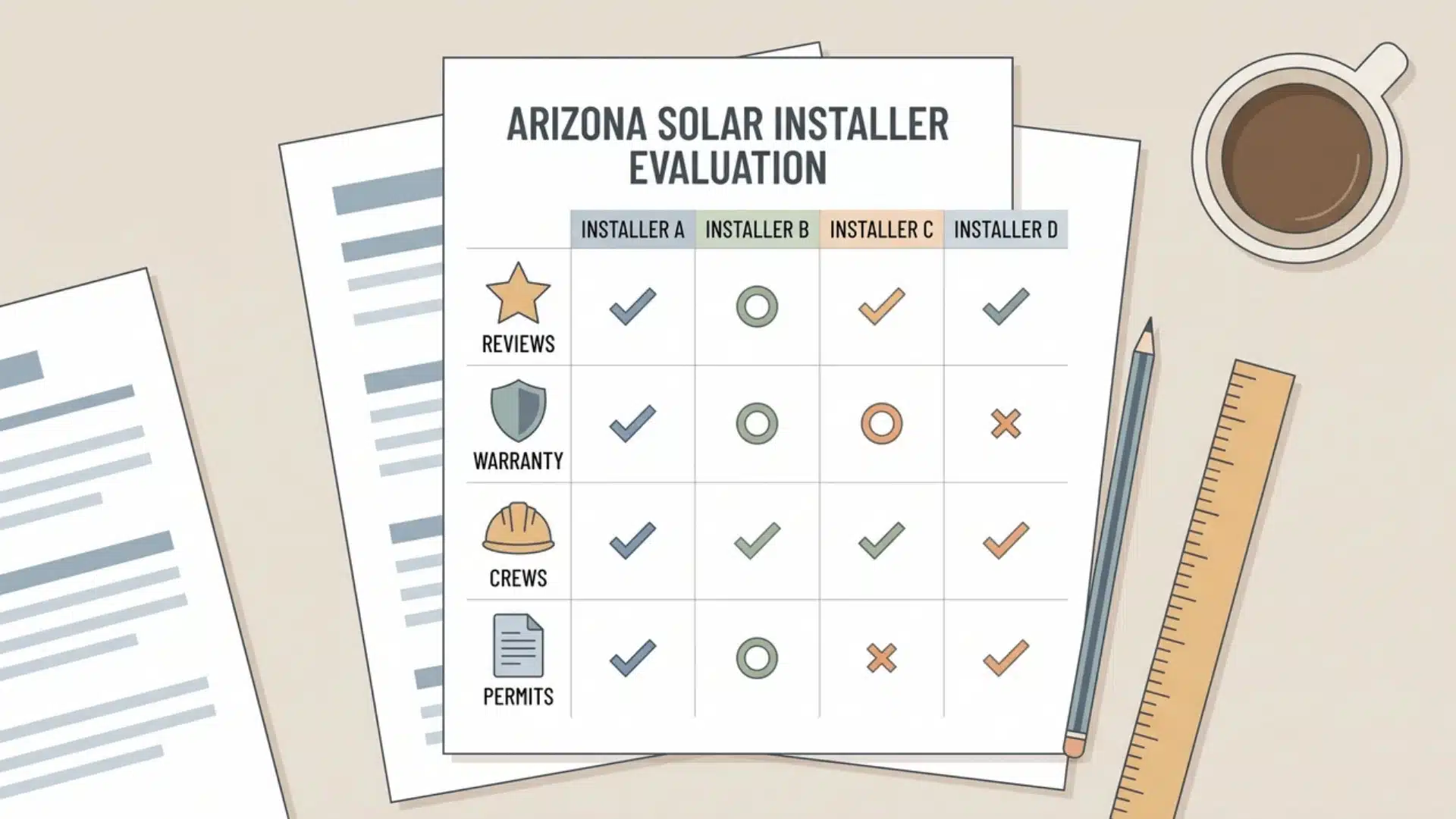
Transparency matters when recommending companies that will work on your home. Here is exactly what went into every placement on this list. Four criteria drove every decision:
- Verified customer reviews (Google, SolarReviews, EnergySage): Patterns across reviews matter more than star ratings alone. Consistent post-install feedback is the strongest signal of reliable operations.
- Warranty structure: Coverage depends on whether the installer backs labor directly or passes responsibility to a third party.
- In-house vs. subcontracted crews: Who actually installs the system determines who shows up when something needs fixing afterward.
- APS and SRP permitting experience: Installers familiar with Arizona utilities handle approvals faster and with fewer delays.
Verified reviews carry the most weight because they reflect real outcomes across a large number of installs, not just sales promises. The other three criteria sharpen the picture where review volume alone doesn’t tell the full story.
APS vs. SRP: How Your Utility Shapes Your Solar System
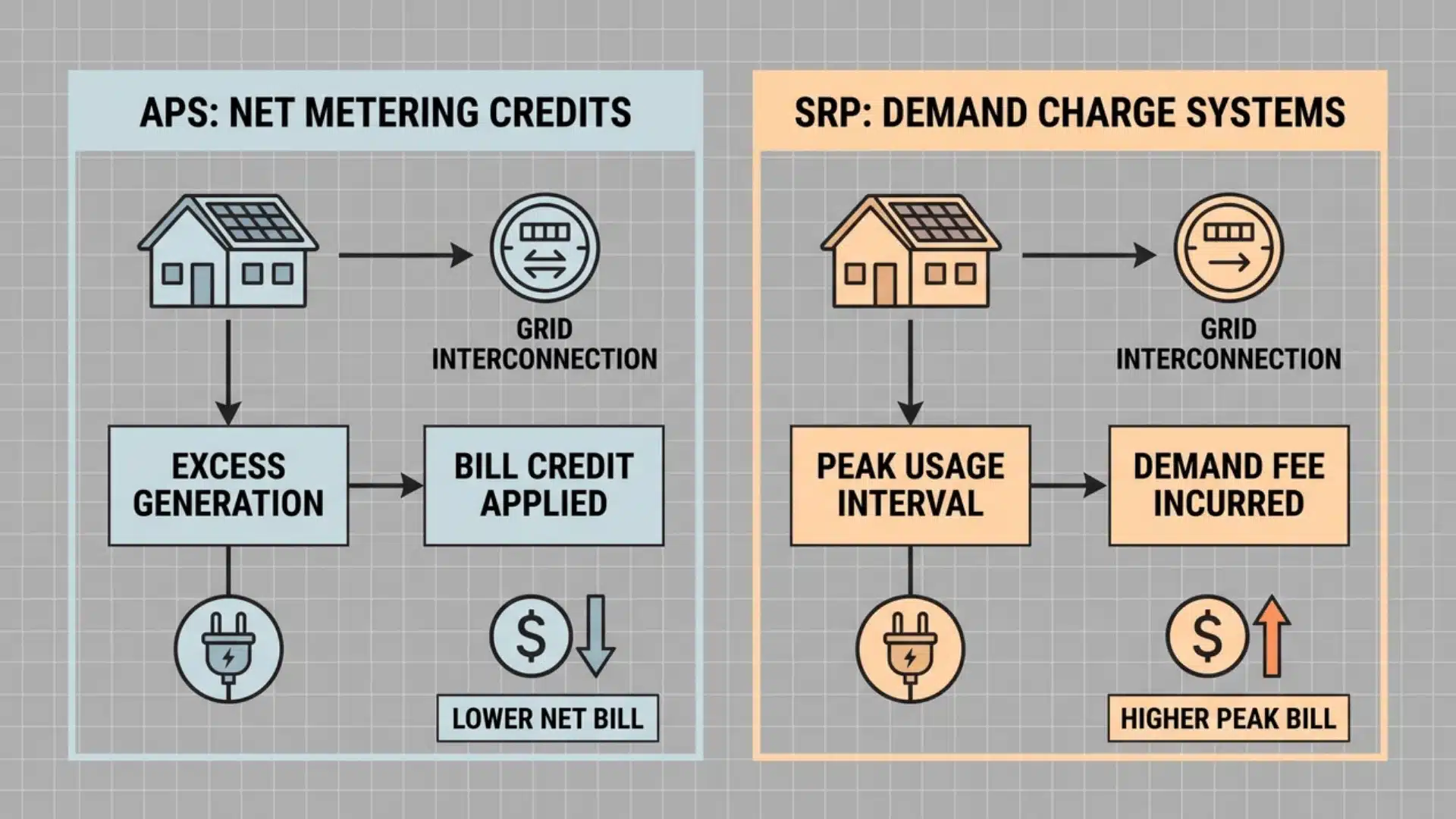
Arizona homeowners are not choosing between the same solar equation. APS and SRP bill differently, incentivize differently, and reward different system designs. Knowing which utility serves your address is not background information; it is the starting point for every sizing and design decision your installer makes.
| Factor | APS | SRP |
|---|---|---|
| Billing Model | Net metering credits against usage | Usage credits plus separate demand charges |
| Excess Energy Value | kWh credits offset future bills at reasonable rates | Excess credits carry lower value, reducing return on oversized systems |
| Peak Demand Charges | Not a billing factor | Major monthly cost driver, can offset solar savings if unmanaged |
| Battery Storage Impact | Increases self-consumption and reduces grid draw | Directly cuts peak demand charges, stronger financial case for storage |
| System Sizing Approach | Size to match annual consumption | Size to manage peak usage profile, not just annual output |
| What This Means for Your Installer | The standard sizing process applies | Requires demand-aware design experience to avoid undersized savings |
| Switchover Complexity | Straightforward interconnection process | Additional steps around demand rate plan selection at signup |
The utility serving your address is not a minor detail. It determines how your system should be sized, whether battery storage makes financial sense, and which installers are genuinely equipped to design around your billing structure.
What to Look for in Any Arizona Solar Quote
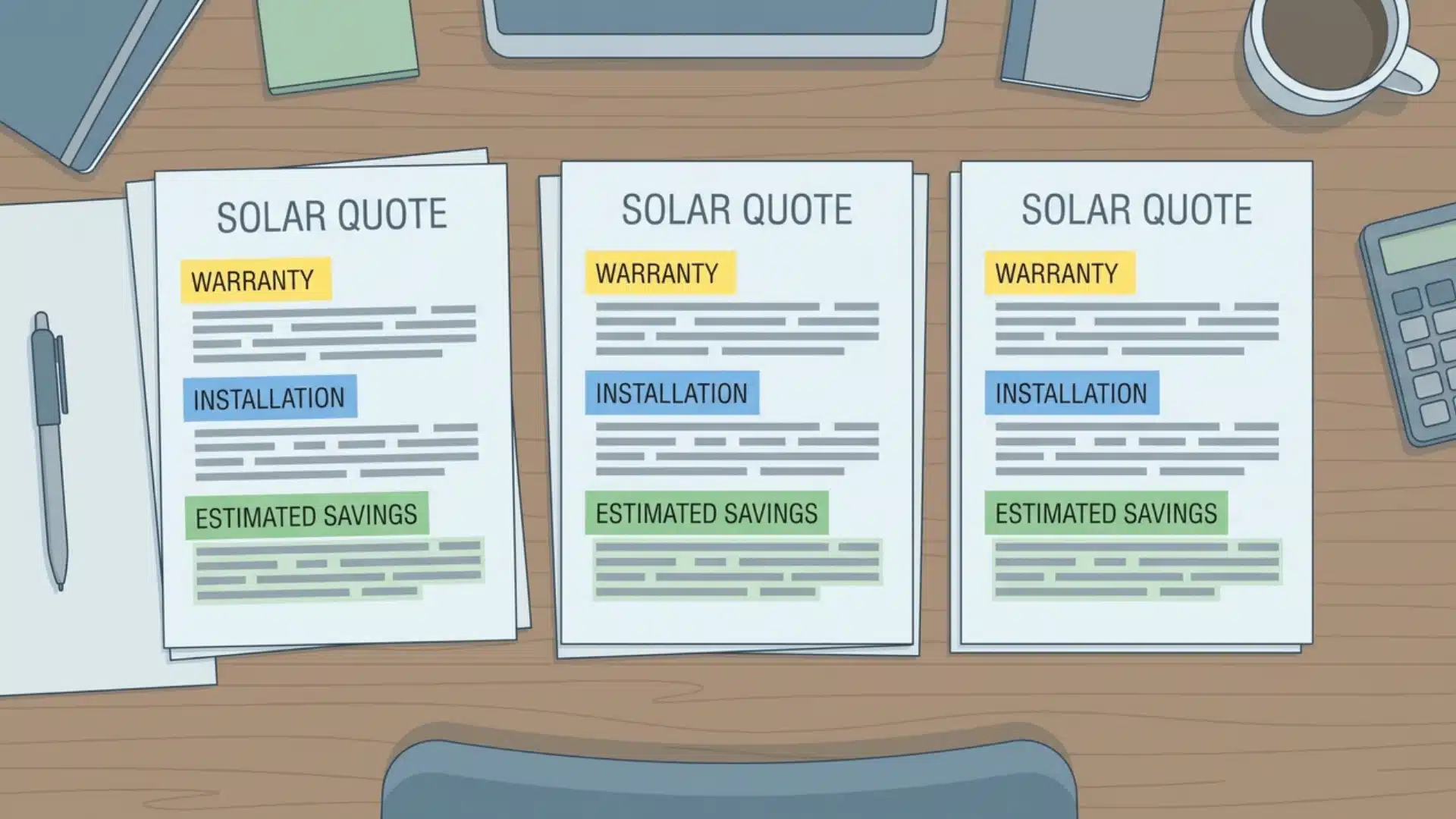
Getting multiple quotes is standard advice. What most homeowners miss is what to actually look for when those quotes arrive.
Labor Warranty Scope and Length
A panel warranty covers the panels. It does not cover roof penetrations, electrical connections, or mounting hardware. That is what the labor warranty covers, and it gets tested far more often.
Ask specifically whether the labor warranty covers roof and electrical work or just installation labor. Those are different things, and a confident installer will answer without hesitation.
In-House vs. Subcontracted Installation
When an installer subcontracts the work, the company you signed with is no longer the company on your roof. If something goes wrong later, you are stuck between two businesses arguing over responsibility.
Ask directly: Will your own employees install this system? If the answer includes “trusted partners” or similar phrasing, follow up. You should know this before signing, not after.
Whether Savings Projections Use Your Actual Rate Structure
Projections built on national average rates look better than ones built on your real APS or SRP plan. Ask which rate plan was used to model your savings and request a rerun if it was generic.
Any installer worth hiring will do this without pushback. If they won’t, that tells you what you need to know.
Conclusion
Solar in Arizona comes down to fit. The right installer depends on your roof, your utility, and how you plan to finance the system.
Warranty scope, crew type, and utility modeling matter more than headline price. Those details separate a solid install from one that creates problems later.
Start with two or three local quotes. Compare them carefully across the criteria covered in this guide, not just the bottom line number.
The installer who explains everything clearly, without pushback on the hard questions, is usually the one worth trusting with your roof.
Frequently Asked Questions
Who is the best solar company in Arizona?
For most Phoenix-area homeowners, Solar Topps and Sun Valley Solar Solutions rank highest. They combine strong verified reviews with in-house labor warranties and proven experience across both APS and SRP. The best choice between them, and between local and national options comes down to whether you’re buying, financing, or leasing, and which utility serves your address.
How much does solar installation cost in Arizona?
Most whole-home systems in Arizona run between $15,000 and $30,000 before incentives. As of 2026, the 30% federal tax credit no longer applies to purchased or financed systems; that credit ended after 2025. Leasing or a PPA is now the only path to any federal credit, since the leasing company claims it and may pass some savings through. Local Arizona solar installers typically quote around 10% less than national providers for comparable systems.
Is it better to buy or lease solar panels in Arizona?
Buying still wins on long-term value, you own the asset and aren’t tied to a lease if you sell. What’s changed: buying no longer includes the federal tax credit. That 30% credit now only flows through leasing or a PPA, where the company claims it. Leasing lowers the upfront barrier but generally costs more over time.
How long does a solar installation take in Arizona?
The physical install usually takes one to three days. The full timeline inlcuding permits, utility interconnection, and final inspection typically runs six to twelve weeks. Installers with established relationships at APS or SRP move through that process faster. It’s a reasonable question to ask any installer before you sign: how many installs have you completed with my utility in the last 12 months?