


How many solar panels do I need? This is a simple question with a surprisingly specific answer, one that depends entirely on your home, not a national average.
People trying to figure out how many solar panels are needed to power a house often start with the wrong variable and end up with a system that’s either too small or oversized.
They guess based on house size or copy a number from an article written for a different state.
Both approaches lead to the same problem. The numbers that actually matter are how much electricity you use, where you live, and what sits on your roof. Miss any one of them and the whole estimate shifts.
Get those three things right, and the rest is straightforward math. Here’s how to work through each one.
How Many Solar Panels Do You Actually Need?
The number of solar panels your home needs follows directly from how much electricity you use, and finding that number starts with your utility bills.
It feels logical, but it doesn’t hold up. Two 2,000 sq ft homes can have wildly different energy needs depending on how many people live there, what appliances they run, and whether they have electric heating or cooling.
What actually drives panel count is your annual kilowatt-hour (kWh) consumption. Pull your utility bills from the last 12 months and add up the total kWh used.
Don’t rely on a monthly average; it smooths out the seasonal spikes that affect how your system needs to be sized.
The U.S. average sits around 10,500 kWh per year.
That’s useful as a reference point. But it’s not your number unless it matches what your bills actually show. Get your real figure first. Everything that follows depends on it.
Quick Estimates by House Size
If you don’t have your utility bills handy, this table gives a working starting point based on average U.S. consumption and 400W panels.
| Home Size | Estimated System Size | Estimated Panel Count (400W) |
|---|---|---|
| 1,500 sq ft | 5–6 kW | 13–16 panels |
| 2,000 sq ft | 7–9 kW | 18–23 panels |
| 2,500 sq ft | 9–11 kW | 23–28 panels |
| 3,000+ sq ft | 11–13 kW | 28–33 panels |
These figures assume average consumption for each home size. If your household runs higher than average due to electric heat, an EV, or older appliances, add 15–20% to the shown panel count.
Pull your actual kWh data before finalizing anything.
What Peak Sun Hours Are and Why Your Location Changes Everything
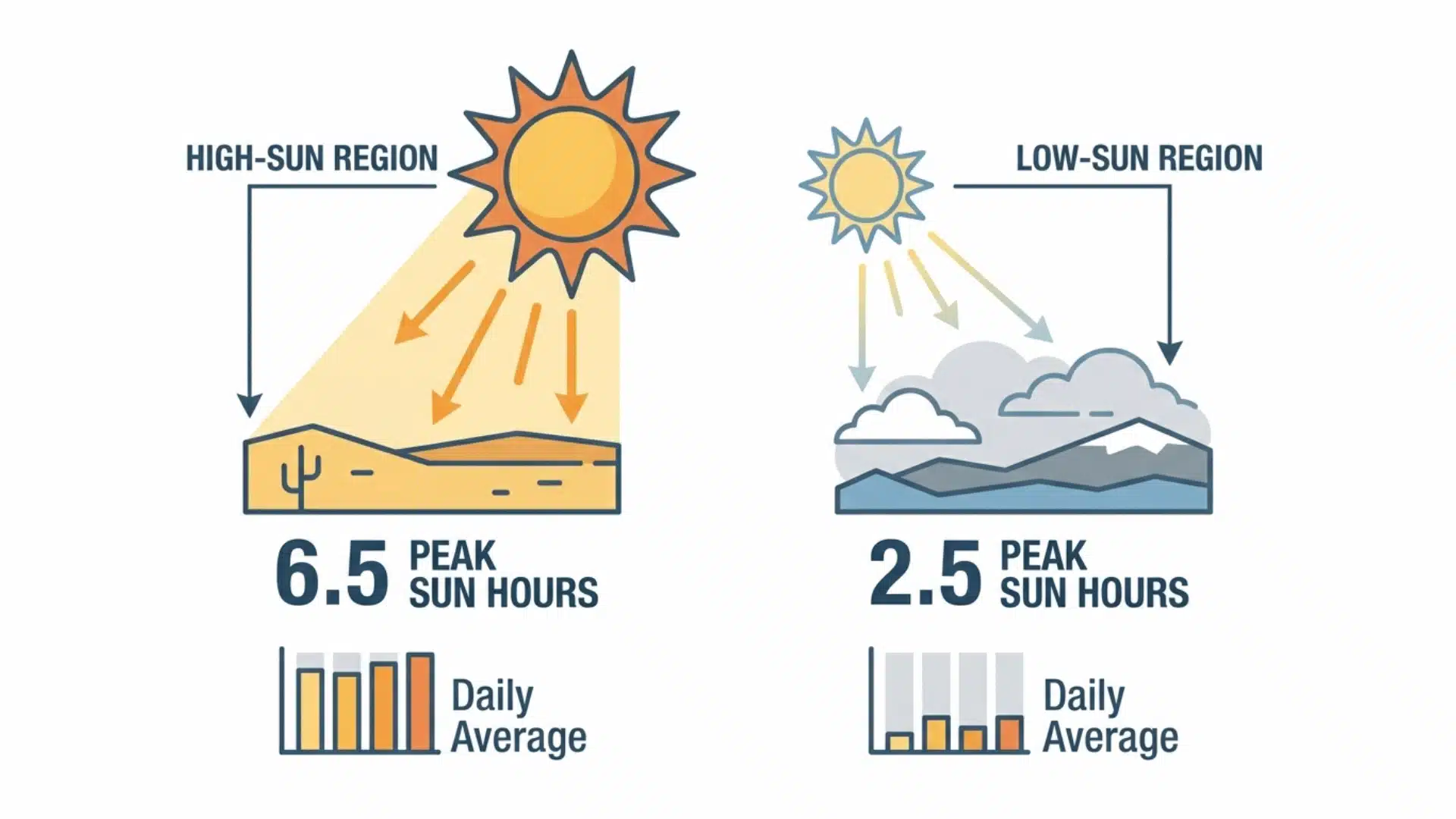
Most people assume cloudier climates just need a few extra panels. The real difference is large enough to change the entire scale of your system. It comes down to peak sun hours, and what that term actually means matters here.
Peak sun hours are not the same as daylight hours. A cloudy region might have nine hours of daylight but only 3.5 peak sun hours. A desert region with the same daylight might deliver 6.5.
The difference is intensity. Peak sun hours measure equivalent hours per day at a standardized 1,000 W/m², and that gap is what drives panel count.
Take two identical households, both using 10,500 kWh per year. Arizona gets around 5.5 peak sun hours, which roughly corresponds to a 6 kW system. Massachusetts gets around 4.0; that’s 9–10 kW.
Same lifestyle, same consumption, seven to ten more panels. The difference is productive hours, not how the panels work.
Fewer peak sun hours mean less output per panel. Check your local figure on the NREL PVWatts Calculator before sizing anything.
Panel Wattage: How Power Output Per Panel Affects Your Count
Panel wattage is the third variable, simpler than peak sun hours, but one part of it consistently trips people up:
- Rated wattage is a peak figure, not an all-day average. A 400 W panel in a 5-peak-sun-hour location produces roughly 2 kWh per day, not 400 watts every hour.
- Residential panels today typically range from 400 W to 450 W. Higher wattage means more output per panel, which means fewer panels are needed for the same system size.
- Higher wattage costs more per panel. The trade-off is space versus upfront cost. If your roof is limited, higher-wattage panels let you fit more output into less space.
- If roof space isn’t a constraint, lower-wattage panels may reduce your total cost. You’ll need more of them, but the per-panel savings can offset that.
- Panel wattage also affects your inverter sizing. A higher-wattage array pushes more peak power through the system, and an undersized inverter will clip that output even on ideal days. Make sure your inverter is rated to handle your array’s full peak output.
The wattage you choose doesn’t change your energy target. It changes how many panels you need to hit it. Pick based on your roof situation first, then your budget.
The Formula: How to Calculate Your Panel Count
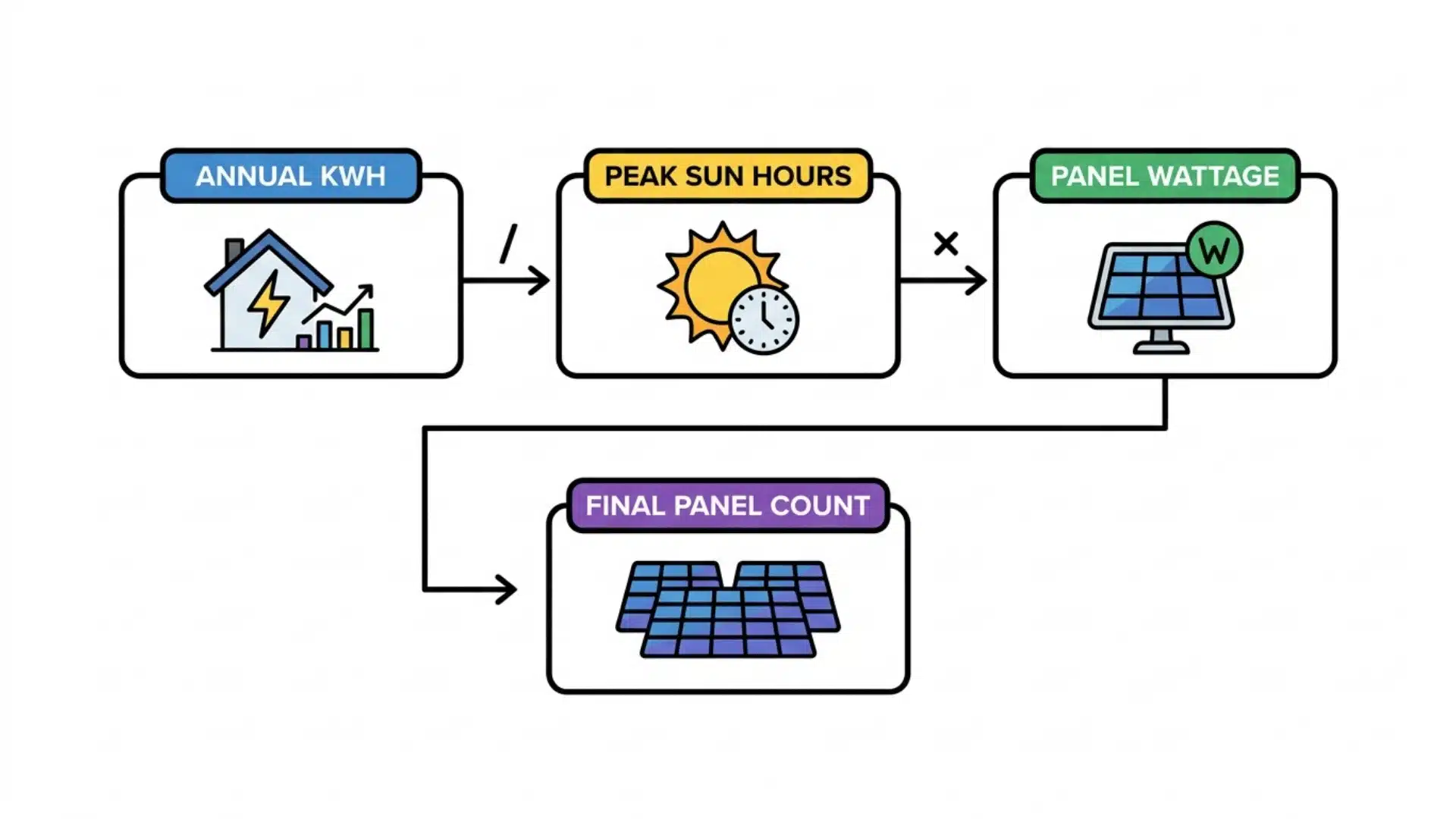
You now have the three variables you need. Here’s how they fit together.
(Annual kWh ÷ (365 × peak sun hours × system efficiency)) ÷ panel wattage in kW = number of panels
System efficiency (also called the derate factor) is typically 0.8, accounting for real-world energy losses such as inverter losses, heat, wiring, and shading.
Each step produces something useful:
- Annual kWh ÷ 365 gives your daily energy need in kWh
- ÷ peak sun hours converts that into the required system size in kW
- ÷ system efficiency (≈0.8) adjusts for real-world losses
- ÷ panel wattage in kW converts the system size into the number of panels
Each step builds on the previous one. Follow them in order, and you get a realistic system size instead of an idealized estimate.
Worked Example: High-Sun Region (Arizona)
Annual use: 10,500 kWh. Peak sun hours: 5.5. Panel wattage: 400 W (0.4 kW). System efficiency: 0.8.
10,500 ÷ (365 × 5.5 × 0.8) = 6.5 kW system
6.5 ÷ 0.4 = 16.25 → 16–17 panels
Worked Example: Low-Sun Region (Massachusetts)
Annual use: 10,500 kWh. Peak sun hours: 4.0. Panel wattage: 400 W (0.4 kW). System efficiency: 0.8.
10,500 ÷ (365 × 4.0 × 0.8) = 9.0 kW system
9.0 ÷ 0.4 = 22.5 → 22–23 panels
The formula doesn’t change, only the inputs do. Get those three numbers right, and the panel count takes care of itself.
Factor in Future Energy Needs Before You Size Your System
If you are planning to add an electric vehicle or switch to a heat pump in the next few years, factor that load into your calculation before sizing your system.
- An average EV adds roughly 3,000 to 4,500 kWh per year depending on how much you drive.
- A heat pump replacing gas heating can add 2,000 to 4,000 kWh.
Add either figure to your current annual kWh total and run the number through the formula again before settling on a panel count.
Retrofitting later costs more. Panel prices per unit are higher on small add-on orders, and a second installer visit for system reconfiguration adds labor costs. Sizing up front by 10 to 15% is almost always the cheaper path.
Physical Factors that Can Change the Number Before You Install
The panel count from a formula is only a starting estimate. Real roof conditions affect actual solar production, so final system design is always adjusted on-site.
- Roof Direction (Orientation): South-facing roofs produce the most energy. East- and west-facing roofs usually produce about 10–25% less, depending on location and tilt.
- Shading: Trees, buildings, or chimneys can reduce output. In string inverter systems, shading on one panel can reduce the output of the entire string, though modern systems mitigate this effect.
- Roof Space: Limited roof area can restrict how many panels fit. Each panel typically needs about 18–22 sq ft, so higher-wattage panels may be used if space is tight.
- Panel Technology: Microinverters and power optimizers enable panels to operate independently, reducing losses due to shading and mismatch.
- Roof Tilt (Angle): Panels work best when tilted close to the site’s latitude. Poor tilt can reduce annual output by about 5–15%.
Before final installation, these factors should always be checked. They help turn a rough estimate into a more accurate solar setup for your home.
Wrapping Up
Figuring out how many solar panels you need comes down to three numbers: your annual electricity consumption, your local peak sun hours, and your panel wattage.
None of them is hard to find. What trips most people up is skipping straight to a range for how many solar panels they need without checking whether it fits their actual situation.
A home in Arizona and a home in Massachusetts can have identical lifestyles and still need systems that differ by nearly ten panels.
Do the math with your real numbers, account for what’s on your roof, and you’ll have a system sized to actually do the job. Get quotes after, not before.
Frequently Asked Questions
How long do solar panels typically last?
Solar panels are highly durable and typically last over 25 years, with a gradual efficiency decline of less than 1% per year, and most manufacturers provide warranties for this period.
Can my roof support solar panels?
A roof is suitable if it has ample unshaded space, is in good structural condition, and faces south, southeast, or southwest to maximize sunlight exposure and energy production.
Do solar panels need direct sunlight to work?
Solar panels do not require direct sunlight to generate power. They produce electricity from both direct and indirect light on cloudy days, although their output will be reduced compared to full sun conditions.
Does a bigger house always need more solar panels?
Not necessarily. Panel count is based on electricity consumption, not floor area. A smaller home with electric heat and an EV can easily need more panels than a larger, more efficient one.