

Tilt angle gets treated like a precise science, but installations that nail the number while ignoring shading or soiling consistently underperform ones that do not.
The optimum angle for solar panels is a starting point, not a verdict. Latitude gives you the baseline, but your roof, your usage pattern, and your tariff all pull that number in different directions.
The gap between theoretical perfect and practically good enough is smaller than most people expect. A few degrees off optimal costs less than one might think.
What actually matters is understanding which variables move the needle for your specific situation, and that is exactly what I’ll cover today.
Why Tilt Angle Affects How Much Energy Your Panels Produce
Solar panels generate the most electricity when sunlight hits the panel surface at a right angle. Tilt away from that and the same light spreads across a larger area, reducing output.
That spreading effect follows a cosine curve, which is forgiving near its peak. A panel 15 degrees off its ideal angle typically loses between 3 and 10 percent of potential output depending on base tilt and latitude, not a proportional 15 percent.
The sun’s noon elevation also shifts throughout the year, sitting low in winter and high in summer. No fixed tilt is perfect for every day, so the goal is minimizing losses across all seasons combined.
What the Latitude Rule Actually Optimizes For
Setting a solar panel’s tilt equal to your latitude maximizes total annual energy production for a fixed installation, but that is a specific goal, not necessarily the right one for every household.
Here is what the latitude rule actually does for you:
- It centers your panel’s orientation on the average noon sun elevation across all 365 days, capturing the best cumulative irradiance a fixed angle can achieve year-round.
- It trades winter performance against summer performance in equal measure, meaning it does not maximize either season, just balances both into the strongest annual total.
- It was derived for fixed, unshaded panels chasing kWh totals, so it says nothing about when during the day or year your household actually consumes the most power.
That last point is where most solar guides stop short. Optimizing for total annual output and optimizing for your actual energy needs are two different problems, and the latitude rule only solves one of them.
The latitude rule is a reliable starting point, but knowing what it does and does not optimize for puts you in control of a smarter installation decision.
How Latitude, Season, and Energy Goals Change the Optimal Angle
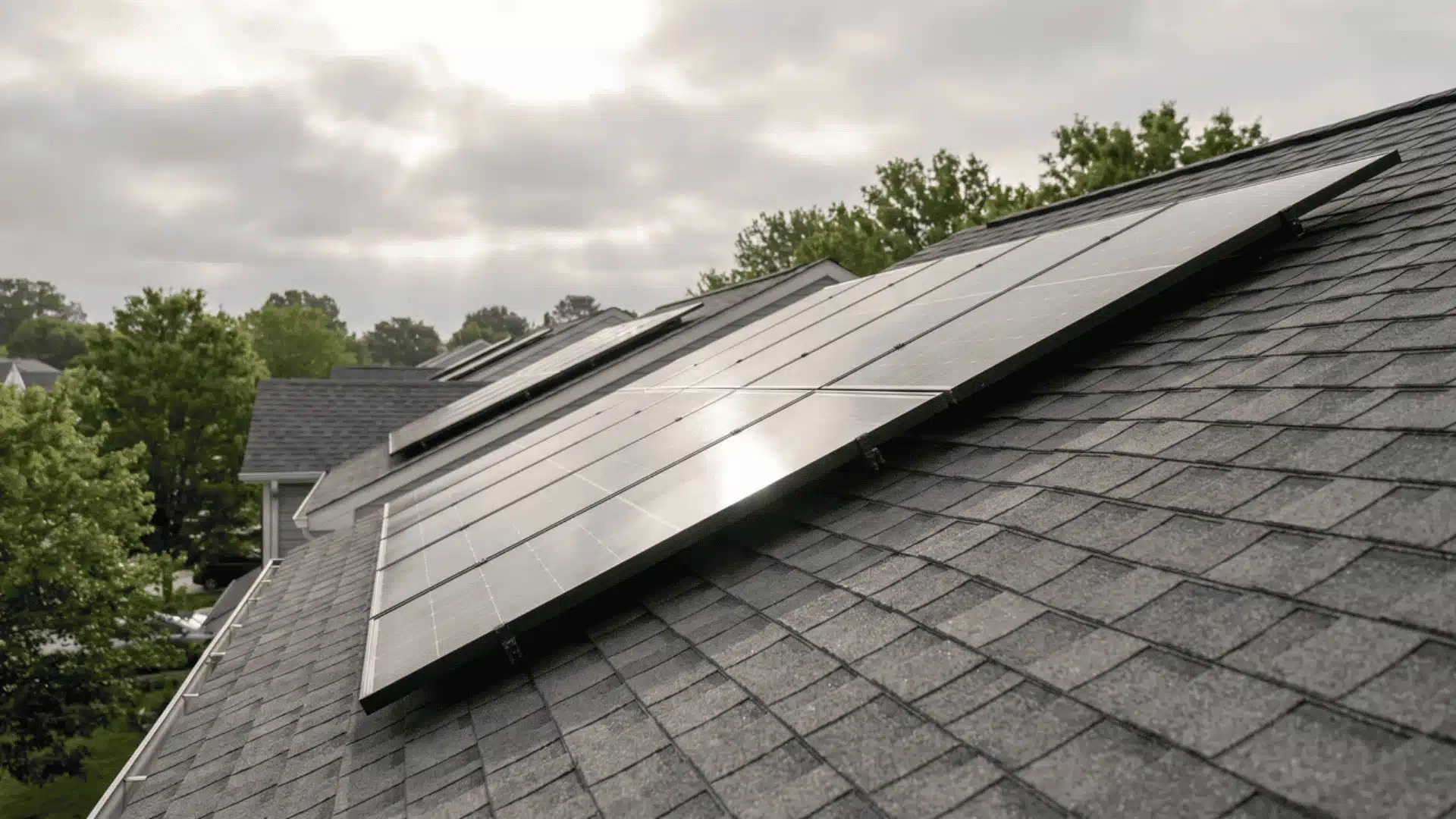
The best solar panel tilt angle depends on whether you are optimizing for total annual output, winter heating offset, summer cooling offset, or peak-hour financial return. These are four different targets that produce four different answers.
Annual Fixed Tilt
If your energy use is fairly consistent throughout the year, a fixed tilt at your latitude is the right call. Here is what that gives you:
- The strongest cumulative kWh total a fixed panel can produce without seasonal adjustment or manual repositioning.
- A balanced trade-off across all seasons, meaning no single month is dramatically over or underserved by your panel angle.
For most homeowners with steady year-round consumption, the latitude baseline delivers reliable, predictable output without any added complexity or hardware cost.
Winter-Weighted and Summer-Weighted Adjustments
If your load profile skews toward one season, shifting from the latitude baseline makes a measurable difference:
- Adding 15 degrees to your latitude tilts the panel steeper, capturing more of the low winter sun when heating loads and longer nights increase household demand.
- Subtracting 15 degrees flattens the panel slightly, catching more of the high summer sun when cooling loads and longer days drive consumption upward.
Neither adjustment is universally better. The right one depends entirely on when your household uses the most power.
When Your Utility Rate Structure Changes the Answer
Your electricity tariff can matter as much as the sun itself:
- Time-of-use rates charge more during late afternoon peak hours, which means capturing that window efficiently has direct financial value.
- A slight westward azimuth adjustment, rather than a tilt change, can shift your peak generation toward those expensive afternoon hours and reduce your bill more than chasing the perfect tilt angle ever would.
Your optimal angle is not just a physics problem. It is a financial one too, and your utility rate structure is part of the equation.
What Roof Pitch and Structural Reality Mean for Your Actual Tilt
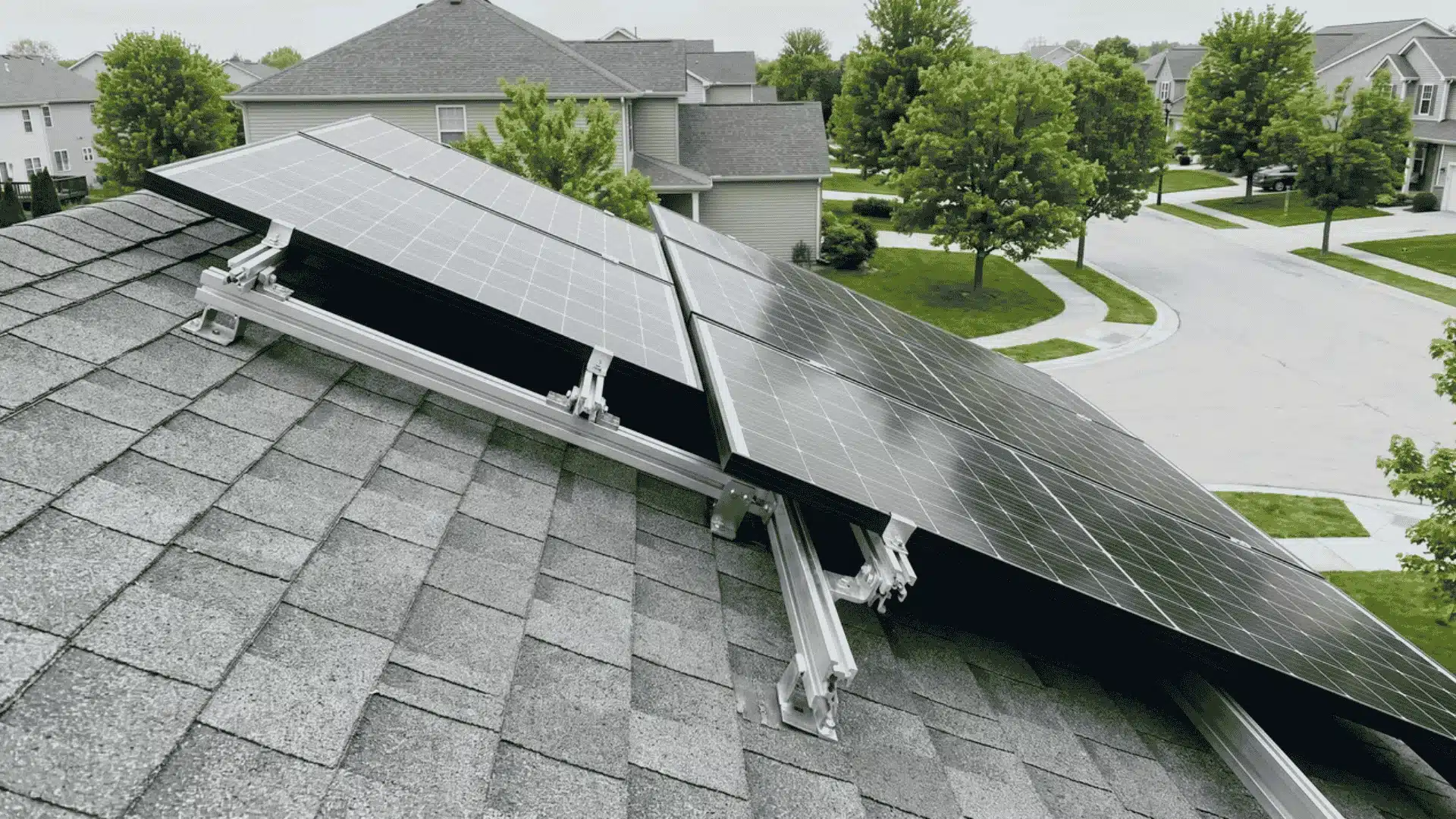
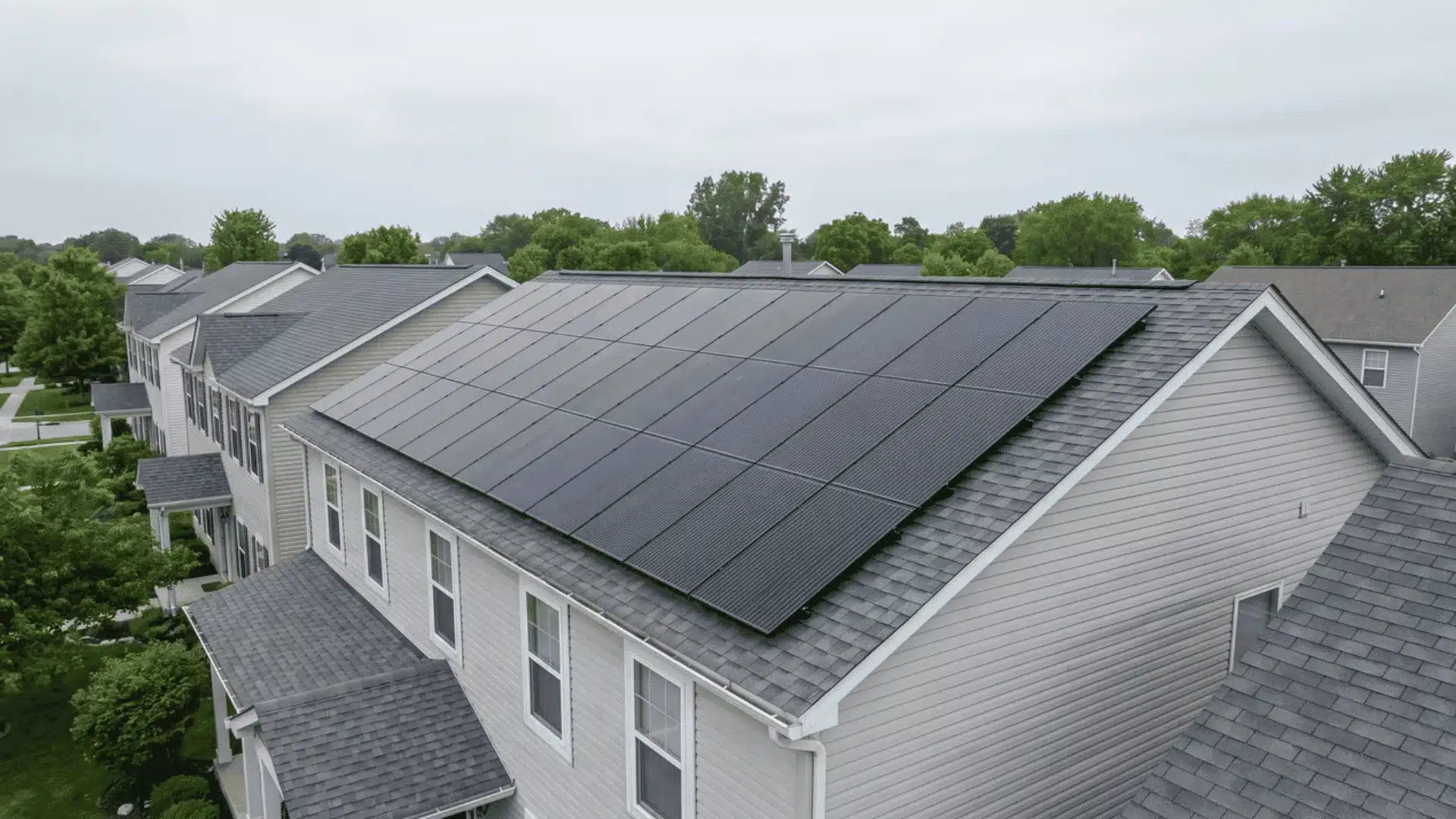
For most U.S. homeowners, the existing roof pitch already falls within a few degrees of the theoretically optimal tilt angle, making flush mounting the practical default.
Most residential roofs sit between 18 and 37 degrees of pitch, which overlaps almost exactly with the optimal range for mid-latitude locations across the continental U.S.
Here is what that means in practice:
- Flush mounting to your existing roof is structurally simpler, cheaper, and aesthetically cleaner than adding tilt-up racking to chase a marginally better angle.
- A tilt-up racking system adds installation cost, increases wind load on your roof structure, and can complicate permitting, all to recover a 3 to 5 percent energy gain.
- Steeper pitches above 30 degrees carry a practical bonus: rainwater sheds dirt, pollen, and debris more effectively, keeping panels cleaner between maintenance visits.
| Roof Pitch | Approximate Degrees | Energy Impact vs Optimal | Self-Cleaning Benefit |
|---|---|---|---|
| Low (2/12 to 4/12) | 9° to 18.4° | 5 to 8% below optimal | Minimal |
| Standard (4/12 to 7/12) | 18.4° to 30.3° | 1 to 4% below optimal | Moderate |
| Steep (7/12 to 9/12) | 30.3° to 36.9° | At or near optimal | Strong |
| Very steep (9/12+) | 36.9°+ | 2 to 5% below optimal | Very strong |
For the majority of homeowners, accepting the roof pitch as your panel angle is not a compromise. It is simply the most practical and cost-effective decision available.
Conclusion
The optimum angle for solar panels comes down to geometry, seasonal demand, roof pitch, and rate structure working together, not a single number applied universally to every home.
The latitude rule is reliable, but it only solves one part of the problem. Knowing its limits is what separates a good installation decision from a great one.
The difference between theoretical perfect and practically optimal is often just 3 to 5 percent. That gap rarely justifies extra hardware or complexity.
Get a site-specific PVWatts calculation before installation day. Ten minutes of scenario testing beats a lifetime of wondering whether the angle was right.
Frequently Asked Questions
Does it matter if my solar panels aren’t at the perfect tilt angle?
For most homeowners, no not significantly. A panel tilted 15 degrees away from the theoretical optimum typically loses between 3 and 10 percent of potential annual output depending on base tilt and latitude. Smaller deviations of 5 to 10 degrees produce proportionally lower losses, meaning roof pitch and shading conditions usually matter more than minor tilt imprecision.
Should solar panels face south, and does that matter more than the tilt angle?
Yes, azimuth (the compass direction panels face) matters as much as tilt, if not more. A south-facing panel at a suboptimal tilt will consistently outperform an east- or west-facing panel at a perfect tilt. In the Northern Hemisphere, due south is the baseline; slight southeast or southwest deviations are acceptable, but large deviations meaningfully reduce output.
What is the best solar panel angle in winter?
For winter optimization, add approximately 15° to your latitude. A homeowner at 40°N latitude would set panels to roughly 55° during winter months to capture the lower sun angle. This applies to adjustable mounts; fixed installations should use the annual average (latitude) as the year-round compromise.
Can solar panels be installed flat, at 0° tilt?
Flat installation is technically possible but not recommended as a permanent setup. At 0°, panels lose efficiency from suboptimal irradiance, accumulate dirt and standing water with no drainage, and are more prone to soiling losses over time. Installers generally recommend a minimum of 10° even in low-latitude locations where flat mounting might seem logical.