

Why does a solar panel labeled 12V sometimes show 20V or more when measured? That mismatch often confuses anyone setting up or testing a system for the first time.
Solar panel voltage is not fixed. It shifts with sunlight, temperature, and wiring setup, which means real readings rarely match the label on the box. Understanding this helps avoid mistakes when designing or troubleshooting a solar setup.
Here, you’ll learn how voltage ratings work, how temperature affects output, and how series and parallel wiring affect system voltage so that you can read your panel data correctly.
What is Solar Panel Voltage?
Solar panel voltage output is a DC signal that varies with sunlight intensity, temperature, and the connected load; it is not a fixed number.
That label on the panel, “12V,” is not what the panel actually produces. It is a system classification, and the real output is always higher. The higher voltage is a deliberate part of the panel’s design. Without it, the panel could not reliably charge a battery.
Every solar panel has three voltage figures on its datasheet: nominal voltage, maximum power voltage (Vmp), and open-circuit voltage (Voc).
Each one measures something different. The next section covers what each figure means and when it applies.
What Do the Three Voltage Ratings on A Datasheet Actually Mean?
Every solar panel datasheet includes three voltage ratings, each corresponding to a different condition. Understanding them helps you choose compatible equipment and interpret real-world voltage readings.
| Voltage Rating | What It Measures | Typical Value (12V Panel) | What It’s Used For |
|---|---|---|---|
| Nominal Voltage | System classification label | 12V | Matching panels to compatible batteries and charge controllers |
| Vmp (Maximum Power Voltage) | Voltage at peak wattage output | 17V–18V | Energy yield calculations and real-world operating performance |
| Voc (Open-Circuit Voltage) | Maximum voltage with no load connected | 20V–22V | Sizing charge controllers and verifying string safety |
Vmp sits above nominal voltage by design; a panel rated 12V nominal needs to produce 17V–18V to overcome the resistance of a partially charged 12V battery and drive current into it.
How Does Solar Panel Voltage Change with Temperature?
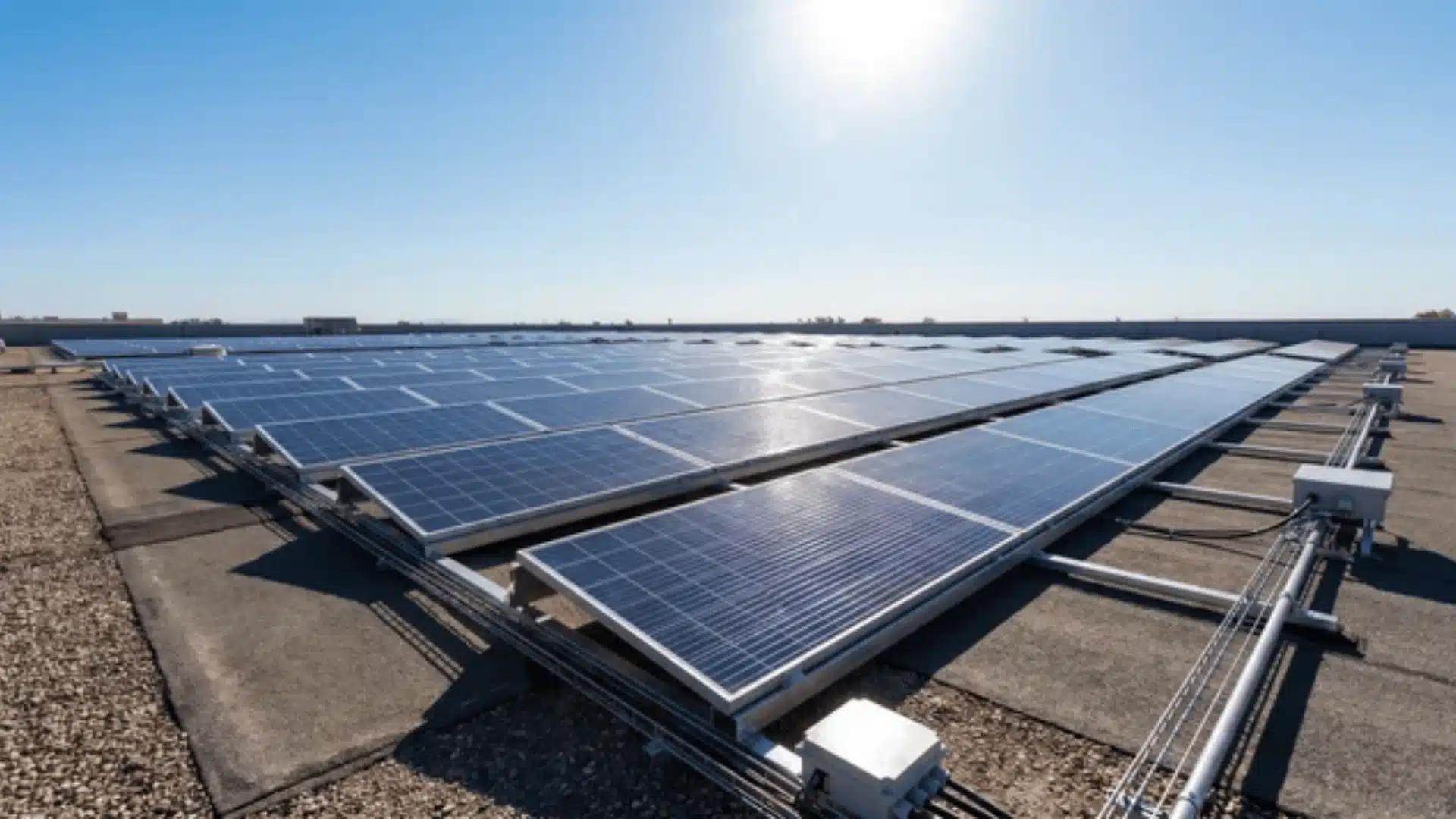
It’s easy to assume that a solar panel will perform better on a hot, sunny day. For voltage, the opposite is true.
As the panel temperature rises, the voltage drops. A cold, clear winter day will produce a higher voltage than a hot summer afternoon, even if the sunlight is just as strong. This is the one relationship in solar that consistently catches people off guard.
Why Temperature Affects Voltage
Solar cells are semiconductor devices. They generate voltage from the potential difference across a p-n junction, the boundary between two layers of silicon with different electrical properties.
When the temperature rises, thermal energy disrupts that junction. It reduces the potential difference, and the voltage falls. The panel is not malfunctioning. The physics is working as it should.
This is why every datasheet includes a temperature coefficient for voltage.
It is expressed as a percentage or millivolts per degree Celsius, for example, -0.29%/°C. That figure tells you precisely how much Voc and Vmp drop for every degree above 25°C.
What This Means in Practice
If your panel’s Voc is 40V at 25°C and the temperature coefficient is -0.29%/°C, a panel temperature of 65°C on a summer afternoon drops Voc by roughly4.6V. That affects string-voltage calculations and charge-controller headroom.
The reverse matters too. On a cold morning at 5°C, Voc exceeds the datasheet value. That is the condition most likely to exceed a charge controller’s maximum input voltage, not peak summer sun.
Size your system to the coldest expected temperature, not the hottest. That is where the voltage ceiling sits.
How Does Wiring Configuration Affect System Voltage?
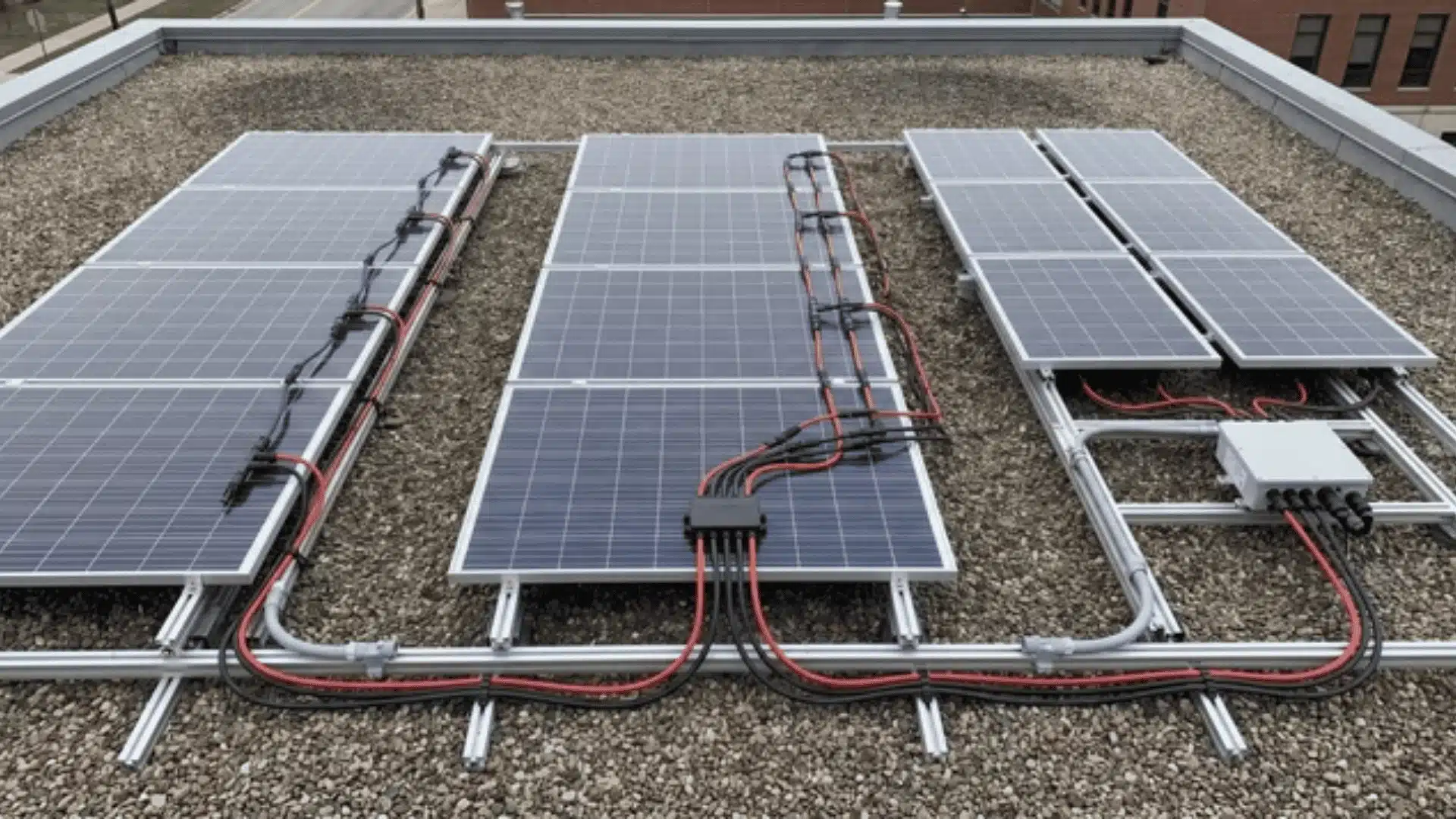
The panels themselves do not determine your system voltage alone. How you connect them does. Two identical panels can produce very different system voltages depending on wiring configuration.
There are two core options, series and parallel, with a third approach that combines both.
Series Wiring
Chain panels positive-to-negative, and the voltage adds up. Current stays the same.
- Two 20V panels in series → 40V output, same amperage
- Used to hit the minimum input voltage of a charge controller or inverter
- Higher voltage means lower current for the same power, which reduces resistive losses across long cable runs
This is the default choice for most grid-tied and MPPT-based off-grid systems.
Parallel Wiring
Connect all positives together and all negatives together. Voltage holds at one panel’s level. Current multiplies.
- Two 20V panels in parallel → still 20V, but double the amperage
- Suits low-voltage systems where current capacity matters more than voltage headroom
- More common in small 12V setups, campervans, boats, and portable systems
Total power is identical either way. The difference is how that power is shaped.
Series-Parallel Combinations
Larger systems use both. Panels are grouped into series strings to build voltage, then those strings run in parallel to increase current. This keeps system voltage within equipment limits while scaling total capacity.
The wiring decision is not flexible once your equipment is chosen. Your string voltage, based on Voc at the coldest expected temperature, must fall within your charge controller’s input voltage window under all conditions. That is the constraint that drives the configuration, not preference.
What Voltage Should You Expect from Your Solar Panel in Real Conditions?
If you measure your panel with a multimeter and the reading does not match the datasheet, that does not mean something is wrong. It is almost certainly normal.
Standard test conditions, 25°C panel temperature, and 1,000 W/m² of sunlight rarely occur together in the real world. Morning light, partial cloud, high ambient heat, or a cool overcast afternoon will all produce a reading that differs from the spec sheet.
Those same conditions also affect how much power a solar panel produces, not just its voltage.
What a Healthy Reading Actually Looks Like
The useful check is not whether your voltage exactly matches Vmp. It is whether Voc, measured with no load connected, falls within a reasonable range for current conditions.
For a nominal 12V panel on a mild, clear day, you should see:
- Voc somewhere between 19V and 22V
- Vmp under load closer to 16V–18V
- Lower readings on hot afternoons, higher readings on cold mornings
If Voc is significantly below the low end of that range in good light, that is worth investigating. A small shortfall on a warm day is not.
A Commonly Overlooked Detail
Cold weather raises voltage, not lowers it. I’ve seen people assume a low winter reading means panel degradation when the panel was actually producing above its rated Voc due to the temperature.
Check the temperature coefficient on your datasheet. Apply it to the current panel temperature. The adjusted figure is your real expected Voc. If the measured voltage sits close to that number, the reading is correct.
Conclusion
Solar panel voltage changes based on sunlight, temperature, and how the system is wired. The “12V” label is only a category, whereas actual operating values like Vmp and Voc vary throughout the day. Temperature plays a major role, with cold conditions increasing voltage and heat reducing it.
Series and parallel wiring also reshape voltage levels, which directly affect system design and safety limits. Because of this, real readings often differ from datasheet expectations.
If you’re planning or checking a setup, the key is understanding how Voc behaves in cold conditions and matching it with your charge controller limits.
Before installation, review your panel datasheet and confirm compatibility with the system voltage step by step.
Frequently Asked Questions
What should the solar panel voltage be?
It depends on which figure you’re checking. For a nominal 12V panel in good condition, Voc should be around 20–22V with no load connected. Vmp under load will be closer to 17V–18V. Both figures shift with temperature and sunlight intensity. A reading that differs slightly from the datasheet is normal, not a sign of a problem.
How do you tell if a solar panel is 12V or 24V?
Check the datasheet or the label on the back of the panel. If you only have a multimeter, measure Voc with nothing connected. A 12V nominal panel will typically read 20V–22V. A 24V nominal panel will read closer to 40V–44V. The physical size of the panel will not reliably tell you the voltage class; voltage class and dimensions are independent.
What voltage does a 400W solar panel produce?
A 400W panel typically has a Vmp of 30V–40V and a Voc of 37–49V, depending on the manufacturer and cell technology. Wattage is voltage multiplied by current, so a higher-voltage 400W panel draws less current than a lower-voltage one at the same power output. Check the datasheet for the exact figures.
Does solar panel voltage change on cloudy days?
Yes, but not as sharply as power output does. Cloud cover reduces irradiance, which lowers both voltage and current, but current falls more. Cooler panel temperatures on overcast days partially offset the voltage drop, so voltage holds up better than wattage does. On a heavily overcast day, expect noticeably lower power but only a moderate voltage reduction.