


Your heating system might not be what you think it is. How do I know if I have a heat pump? That’s the question I get asked most, and it’s trickier than it sounds, because heat pumps and standard air conditioners look nearly identical from the outside.
I lived with one for three years before a technician mentioned it during a routine visit, and I hadn’t caught a single clue. You shouldn’t need a service call to find out.
By the end of this, you’ll be able to check your thermostat, your outdoor unit, and your indoor equipment, and know exactly what’s heating your home in under five minutes.
How Do I Know If I Have a Heat Pump?
You probably have a heat pump if the outdoor unit runs while the thermostat is set to heating mode. Unlike a standard air conditioner, a heat pump uses its outdoor unit to provide both cooling and heating.
That’s the short answer. To be sure, run through four quick checks: your thermostat settings, the outdoor unit’s data plate, how the unit behaves in heating mode, and what’s connected to your indoor equipment. Here’s each one in detail.
Why Identifying Your Heating System Matters
A furnace creates heat by burning gas, oil, or propane, or by using electric resistance elements. A heat pump instead transfers heat between the indoor and outdoor air using refrigerant, a compressor, coils, and a reversing valve, which is why it runs almost year-round.
Because they work so differently, they’re maintained differently too. A heat pump’s service routine covers the outdoor coil, refrigerant circuit, reversing valve, condensate drainage, electrical components, and defrost controls.
A furnace inspection instead focuses on burners, ignition components, heat exchangers, fuel connections, and combustion safety.
Knowing which one you have means you follow the right maintenance of heat pump checklist and can describe your system accurately when calling for service.
Check Your Thermostat First: It Takes Under One Minute
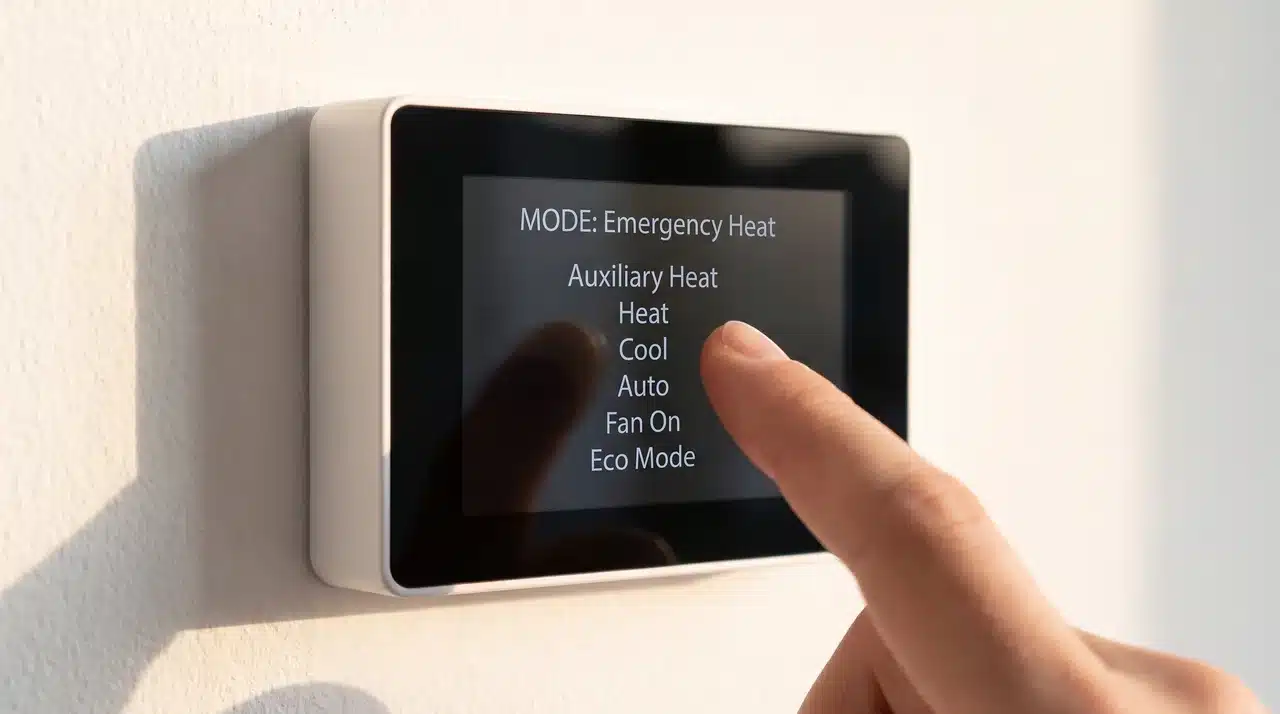
The thermostat is the fastest place to start, since you can check it without opening any equipment or going outdoors. Open the system mode menu and look beyond the standard “Heat,” “Cool,” “Auto,” and “Off” settings; smart thermostats sometimes tuck advanced heating controls inside an equipment or settings submenu.
Auxiliary Heat. “Aux Heat” is a strong sign you have a heat pump. It’s a backup source, electric resistance heat, or, in a dual-fuel system, a gas furnace, that kicks in when the heat pump alone can’t keep up, such as in very cold weather or during a defrost cycle. It typically switches on automatically.
Emergency Heat. “Emergency Heat” or “Em Heat” also points to a heat pump with a separate backup source, but it works differently: it bypasses the heat pump entirely and runs on backup heat alone. It’s meant for when the outdoor equipment has failed, not for everyday use; electric backup heat can be far more expensive to run.
If the thermostat doesn’t help. An older thermostat may hide these settings, and a basic replacement thermostat may not display the original system’s configuration at all. No aux/emergency heat label doesn’t prove you have a furnace; just move on to the equipment checks.
Read the Outdoor Unit Data Plate
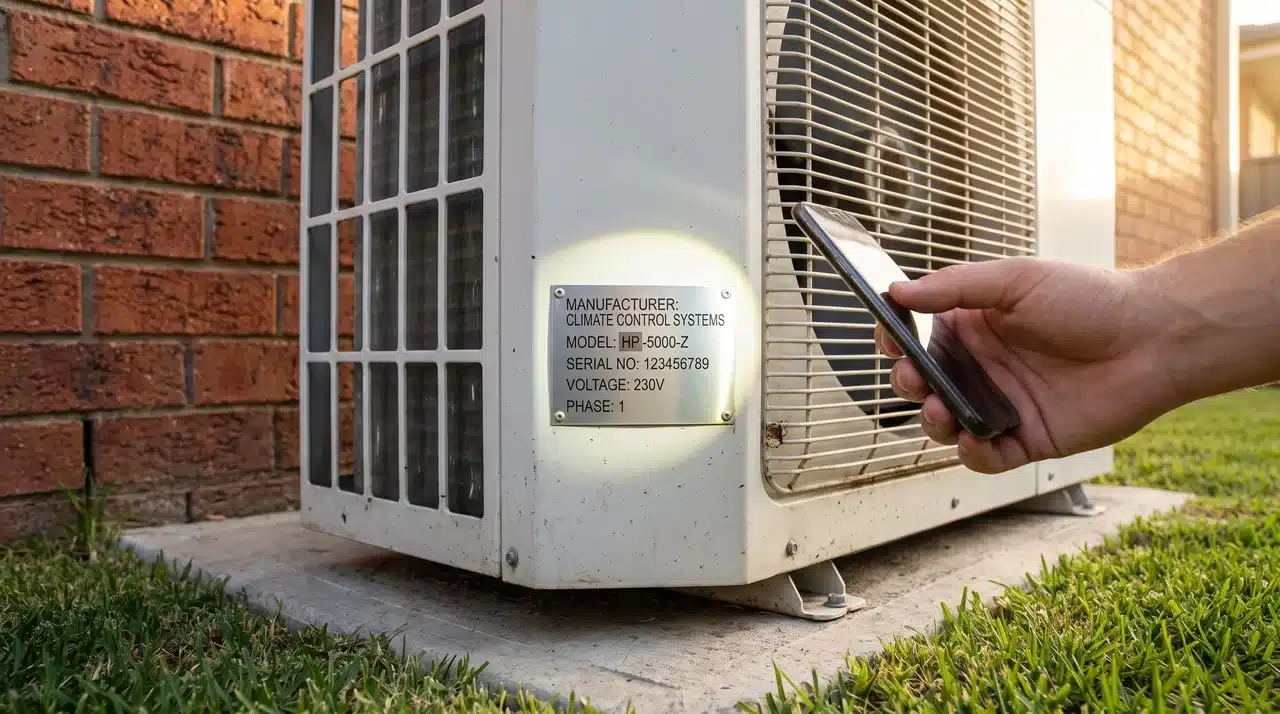
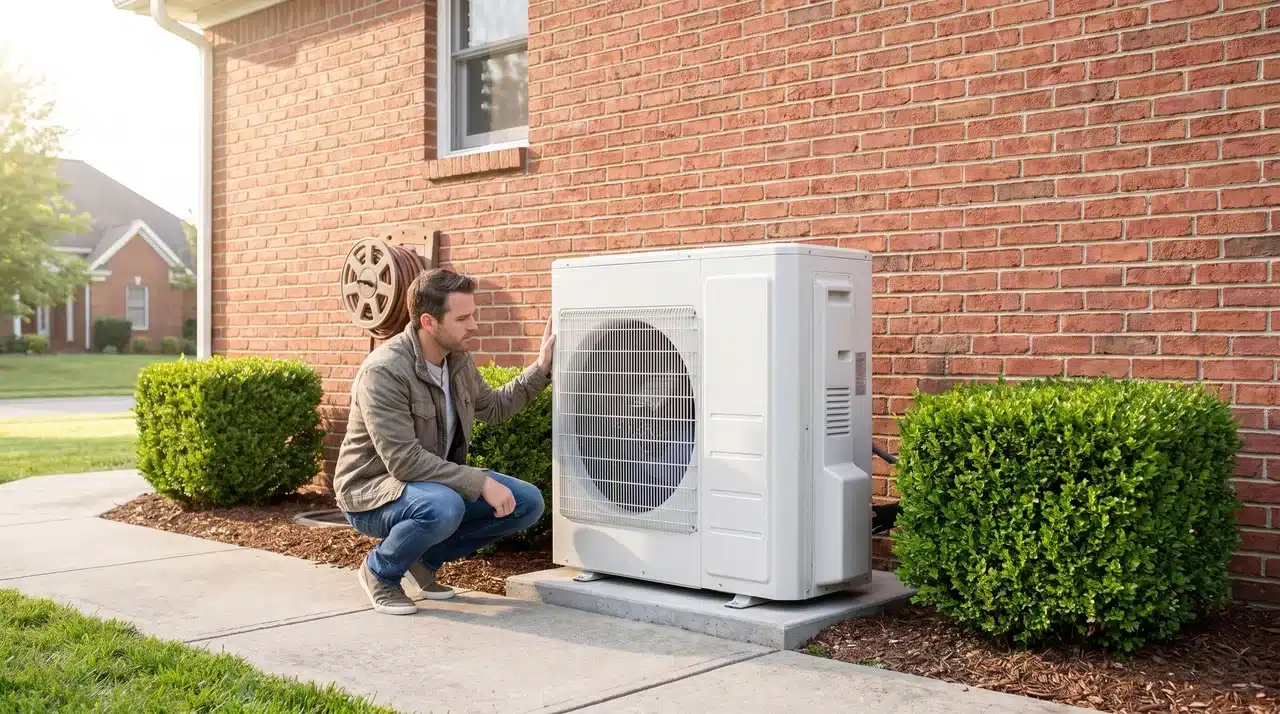
The outdoor cabinet often looks like an ordinary AC condenser, so appearance alone won’t tell you much — the data plate will. It’s usually on the side or rear of the cabinet. Make sure the ground is dry and avoid touching wires, refrigerant lines, or fan guards while reading it.
Record the manufacturer name, complete model number, serial number, and any listed heating/cooling specifications. Some labels say “heat pump” outright; others list both heating and cooling capacities or describe a reversing-cycle system.
Don’t rely on a stray “HP” or “H” in the model number alone; coding systems vary by manufacturer. The most reliable method is searching the full model number on the manufacturer’s official site; the spec sheet will state plainly whether it’s an air conditioner, heat pump, or packaged system.
Check Whether the Outdoor Unit Runs in Heating Mode
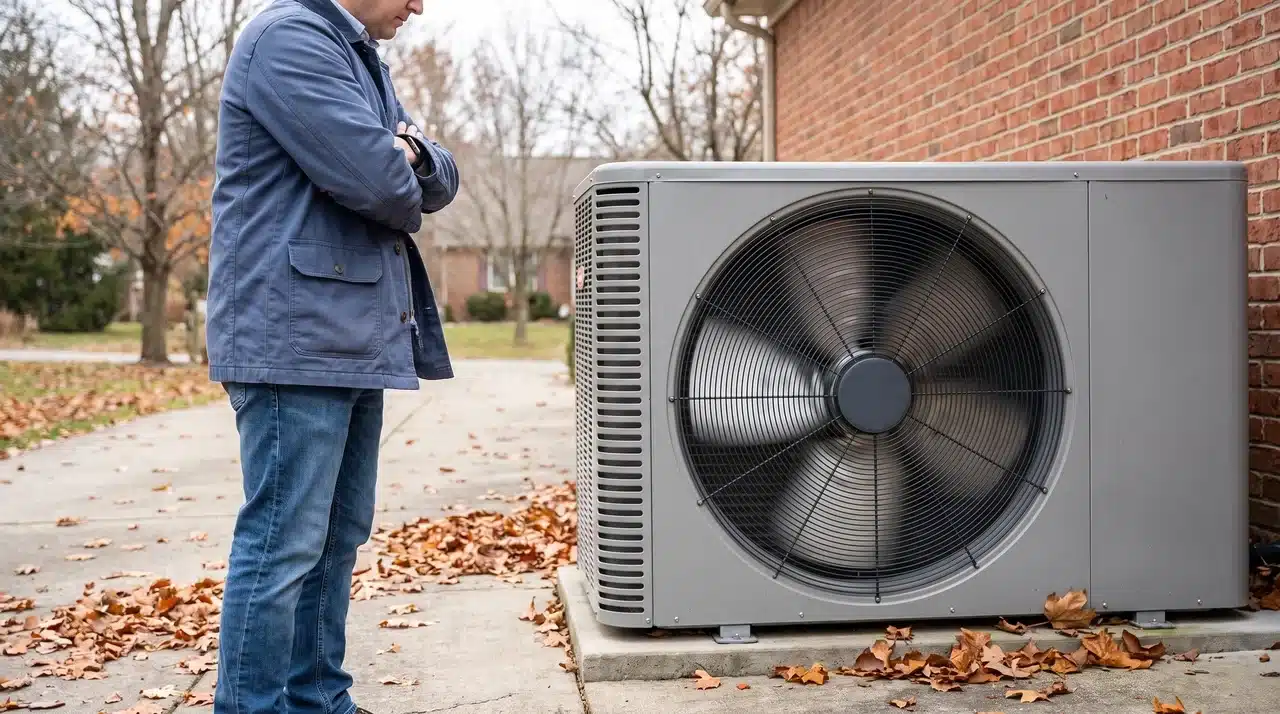
This test works best in mild or moderately cool weather, when the system isn’t likely to lean entirely on backup heat.
- Set the thermostat to “Heat.”
- Raise the temperature a few degrees above the current indoor reading.
- Wait about five minutes for any compressor delay.
- Go outside and observe the unit from a safe distance, don’t remove panels or get near the fan.
- Listen for the compressor and check whether the outdoor fan is running.
| What You Observe | What It May Indicate |
|---|---|
| Outdoor unit runs continuously while the home heats | Heat pump is likely |
| Outdoor unit stays off while warm air enters the home | Furnace or backup heat may be running |
| Unit pauses briefly during heating | Possible defrost cycle or normal delay |
| Outdoor unit and gas furnace both appear connected | Possible dual-fuel system |
A heat pump needs its outdoor coil and compressor to move heat into the home, so it typically runs during heating. A furnace generates heat inside, so its separate AC condenser stays off in winter.
That said, an idle outdoor unit isn’t absolute proof of a furnace; it could just be mid-delay, running on backup heat, or in a fault state. Stop the test immediately if you notice electrical smells, grinding, heavy ice buildup, or sparking.
Inspect the Indoor Heating Equipment
Inspect only the exterior of the unit; don’t remove covers or reach into the cabinet. Look for these signs:
- Fuel-burning furnace: a fuel supply pipe and shutoff valve, a metal or white PVC combustion exhaust pipe, a burner/ignition compartment, and AFUE efficiency ratings on the label.
- Heat pump air handler: insulated refrigerant lines, an indoor evaporator coil, a condensate drain, dedicated electrical breakers, and no fuel line or exhaust flue. It may also contain electric resistance strips used for auxiliary heat.
Finding furnace parts doesn’t rule out a heat pump; it may simply be the backup source in a dual-fuel setup.
Likewise, an all-electric indoor unit isn’t automatic proof of a heat pump, since some homes pair an electric furnace with a cooling-only AC. Cross-check with the outdoor model number or the heating-mode test before deciding
Check the Indoor Unit for a Gas Line or Exhaust Flue
This is the check I wish someone had walked me through earlier. Everything you need to confirm your system type is right there inside your home, and it comes down to looking for two specific things.
A gas furnace cannot run without a gas supply line feeding into it and an exhaust flue carrying combustion gases out. A heat pump has neither of these because it runs entirely on electricity and produces no exhaust at all.
Walk to your indoor air handler unit and look for the following:
- A metal pipe connected to the unit running toward an exterior wall or chimney
- A thicker exhaust or flue pipe exiting through the wall, ceiling, or into a chimney stack
- A gas shutoff valve sitting on a pipe near the base of the indoor unit
If none of these are present, you are looking at a fully electric setup, which points clearly to a heat pump.
There is one situation where both will exist at the same time. A dual-fuel system pairs a heat pump with a gas furnace as a backup heat source.
In that case, you will see a gas line and heat pump hardware together. That is still a confirmed heat pump, just one with a gas-powered backup running alongside it.
Conclusion
Once you know what’s attached to your ductwork, taking care of it gets a lot easier, and I wish I’d known that years ago.
A heat pump and a furnace need different maintenance, so mixing them up means missing the parts that actually matter.
Between your thermostat settings, the data plate on the outdoor unit, how that unit behaves in heating mode, and a quick look for a gas line indoors, you now have everything you need to answer how do I know if I have a heat pump.
No technician visit required, no guesswork left. Check your own system, then take a look at our heat pump maintenance guide to keep it running well.
Frequently Asked Questions
What does a heat pump look like compared to a regular AC unit?
From outside the home, a heat pump condenser and a standard AC condenser look nearly identical. Same boxy shape, same fan on top, same refrigerant lines running indoors. The distinction is internal and in the model number. Visual appearance alone is not a reliable way to distinguish between the two systems without reading the data plate.
Can I have both a heat pump and a gas furnace at the same time?
Yes, and it is more common than many homeowners realize. A dual-fuel system uses a heat pump as the primary heating and cooling source, with a gas furnace as backup when outdoor temperatures drop too low for the heat pump to operate efficiently. Both sets of hardware will be present in this configuration.
How do I know if my heat pump is actually working correctly once I have confirmed what I have?
The clearest sign of proper operation is the outdoor unit actively running in both heating and cooling seasons. Ice persisting on the outdoor coil for more than 15 minutes after a defrost cycle, frequent short cycling, or rising energy bills without a change in usage are signals worth addressing. The main heat pump maintenance guide covers what to check and when.
Does every home with central air have a heat pump?
No. Central air refers to any system that distributes conditioned air through ductwork, including both heat pump systems and standard AC-plus-gas-furnace combinations. Having central air does not confirm the presence of a heat pump. The thermostat check and model number check are the reliable ways to know for certain.