


Your electricity bill keeps creeping up, and it’s easy to overlook your light bulbs as a possible reason.
I know it can seem like a few lights couldn’t make much of a difference, but a handful of forgotten bulbs running for hours a day can quietly add ten or more dollars to your monthly bill.
Understanding how much power do lights use starts with looking at the type of bulb, its wattage, and how long it stays on each day.
Small changes, like replacing older incandescent bulbs with LEDs, can reduce energy use without changing your daily routine.
By the end, you’ll know how to calculate electricity use for lighting, compare common bulb types, estimate running costs, and identify the rooms where switching to LEDs saves the most.
Average Power Consumption of Different Types of Lights
Different lighting technologies use very different amounts of electricity, even at similar brightness. LEDs draw the least power, CFLs land in the middle, and halogen and incandescent bulbs use the most because they waste more energy as heat.
| Bulb Type | Typical Wattage | Efficiency |
|---|---|---|
| LED | 2–18W | Excellent |
| CFL | 9–26W | Good |
| Halogen | 18–70W | Moderate |
| Incandescent | 25–100W | Low |
Most homes use 8–12W LEDs for everyday fixtures. The wattage printed on a bulb shows how much electricity it draws while on — but your bill is actually calculated in kilowatt-hours.
Understanding Watts vs. Kilowatt-Hours
To turn that kWh figure into an actual cost, multiply it by your electricity rate. The U.S. average residential rate is around 19 cents per kWh, though it varies by state.
Using the earlier example, a 10W LED running for 5 hours uses 0.05 kWh, so at 19 cents per kWh that’s less than one cent a day. A 60W incandescent running for the same 5 hours uses 0.3 kWh, or about 6 cents a day, six times the cost for the same amount of light. Over a full year, that gap alone can add up to more than 20 dollars per bulb.
Watts measure electrical power, the rate at which a bulb consumes energy at any given moment. A higher wattage simply means the bulb draws electricity faster while it’s switched on.
Kilowatt-hours (kWh), on the other hand, measure the total electricity consumed over a stretch of time, and that’s the unit utility companies actually bill you for. This distinction matters because a bulb’s wattage alone doesn’t tell you what it costs to run — you also need to know how long it stays on.
The formula is simple: Electricity Used (kWh) = (Watts × Hours Used) ÷ 1,000
For example, a 10W LED running for 5 hours uses: 10W × 5 hours = 50Wh = 0.05 kWh
That single formula is the easiest way to estimate what any light in your home actually costs to run, no matter the bulb type or fixture.
How to Calculate How Much Power Your Light Bulbs Use
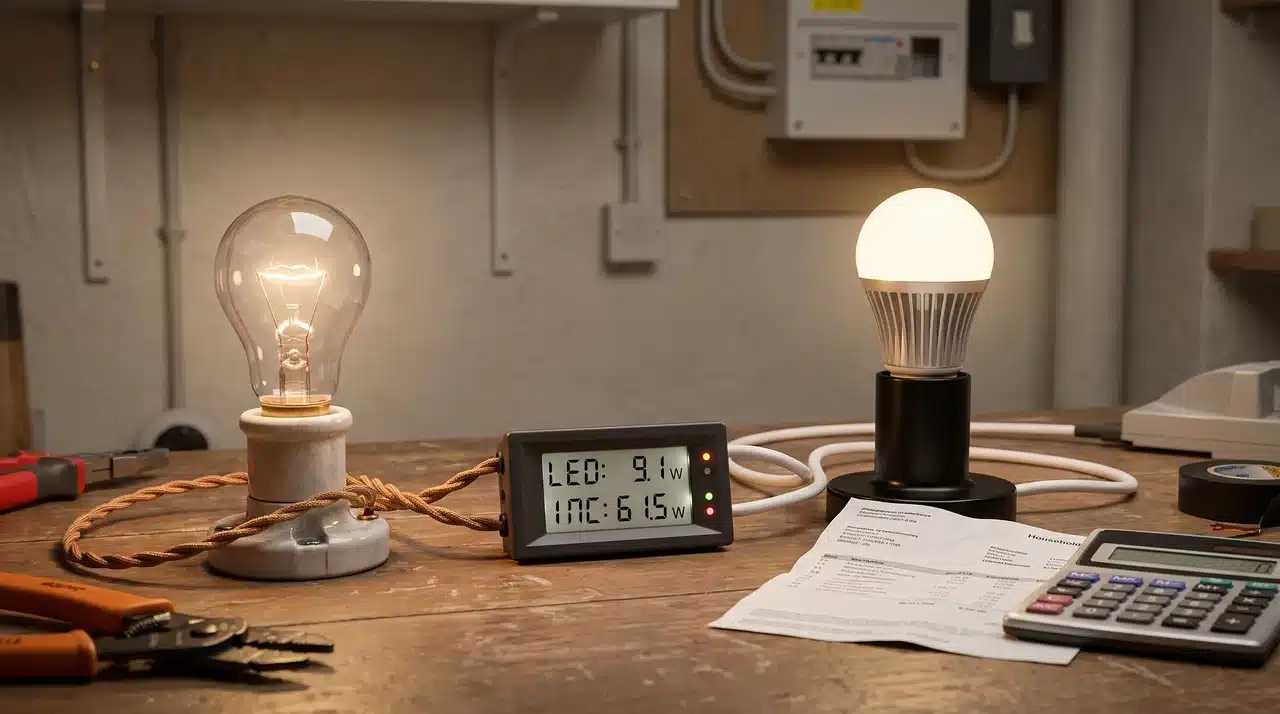
The wattage of a light bulb shows how much electricity it uses, making it the most important factor when estimating energy consumption over time.
Follow these simple steps to estimate how much electricity your lights consume over time.
- Check wattage: Find the bulb’s wattage on the label. This number shows how much electricity the bulb uses while operating and helps estimate energy consumption.
- Calculate daily usage: Divide the bulb’s wattage by 1,000, then multiply it by the number of hours used each day to find daily kWh consumption.
- Compare bulb types: A 10W LED running for 3 hours uses about 0.03 kWh per day, while a similar 60W incandescent bulb uses about 0.18 kWh per day.
- Estimate household usage: Add the consumption of all bulbs in your home to understand total lighting energy use and get a more accurate monthly estimate.
Once you know how to calculate bulb power usage, you can make better lighting choices and reduce unnecessary electricity consumption.
How Much Electricity Do Lights Use Per Hour, Day, Month, and Year?
Multiplying wattage by hours run shows exactly how usage scales over time. Here’s how a 10W LED compares with common incandescent bulbs across an hour, a day, a month, and a year.
| Bulb | Per Hour | Daily (5 hrs) | Monthly | Annual |
|---|---|---|---|---|
| 10W LED | 0.01 kWh | 0.05 kWh | 1.5 kWh | 18.25 kWh |
| 60W Incandescent | 0.06 kWh | 0.30 kWh | 9 kWh | 109.5 kWh |
| 100W Incandescent | 0.10 kWh | 0.50 kWh | 15 kWh | 182.5 kWh |
Longer operating hours raise consumption faster than most homeowners expect. Running a bulb for eight hours instead of five can increase its annual total by more than 50%.
Factors That Affect Light Power Consumption
Several factors combine to determine how much your lights actually cost to run, beyond just the wattage printed on the box.
1. Bulb Technology
LED, CFL, halogen, and incandescent bulbs all convert electricity into light at very different efficiency levels. LEDs waste almost none of that energy as heat, while incandescent bulbs waste most of it, which is why bulb type is the single biggest factor in your lighting costs.
Upgrading just the bulbs you use most often typically delivers the fastest, most noticeable drop in your monthly electricity bill, even before you touch anything else.
2. Daily Operating Hours
Lights used six hours a day consume twice as much electricity as lights used three hours a day, even if the wattage never changes.
This is why a porch light or kitchen fixture left on for most of the day can end up costing more over a year than a brighter bulb that’s only switched on for an hour or two at a time. Tracking actual hours of use, not just assumed use, gives a far more accurate cost picture.
3. Brightness
Higher-lumen bulbs generally require more electricity to produce that extra light output, though efficient technology can offset a lot of that increase.
A bright 1,600-lumen LED can still use less power than a dim 40-watt incandescent, which is why comparing lumens to wattage matters more than comparing bulbs by their brightness labels alone. Choosing the right lumen level for each room helps you avoid paying for light you don’t actually need.
4. Number of Bulbs
Multiple fixtures running at once add up quickly, even if each individual bulb is low-wattage.
Six 10W recessed LEDs running for 4 hours use 0.24 kWh a day — about 7.2 kWh a month, roughly the same as leaving a single 60W incandescent on for over 24 hours straight. Fixture count matters just as much as the wattage of any one bulb when estimating a room’s real running cost.
5. Smart Lighting
Timers, motion sensors, and dimmers all reduce total runtime or effective wattage, lowering consumption without requiring you to change your habits manually.
A motion sensor in a rarely used hallway, for instance, can dramatically reduce that fixture’s daily runtime compared with a switch someone forgets to flip off, making smart controls one of the easiest passive savings upgrades available.
How Much Do All the Lights in a Home Use Together?
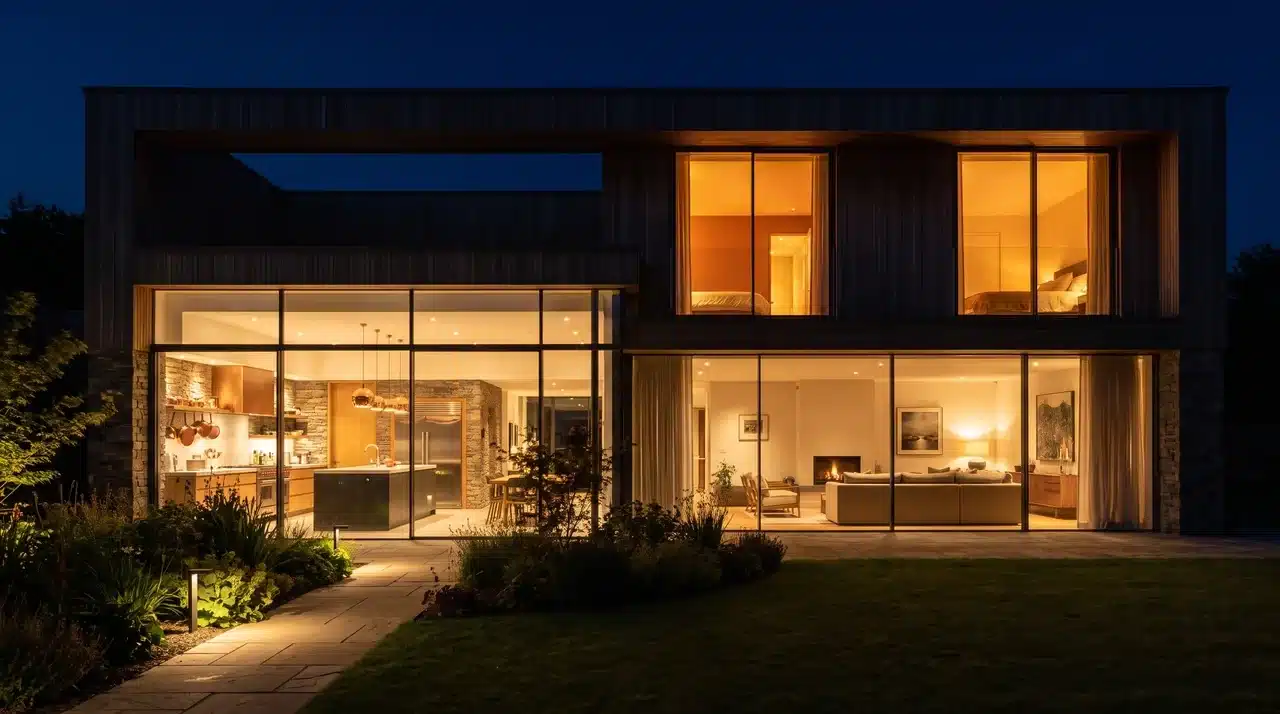
Many people calculate one bulb and assume that it tells them something useful about their lighting bill. It does not, because no room in a typical home runs just one bulb at a time.
Here is what actually drives whole home lighting consumption:
- Bulb type matters far more than anything else. A home running 20 incandescent bulbs consumes roughly six times as much electricity for lighting as an identical home running 20 LED bulbs producing the same brightness throughout.
- Daily hours per room compound the difference significantly. Kitchens and living rooms running four to six hours daily contribute far more to monthly consumption than bedrooms running one to two hours, even with similar bulb counts in each space.
- Running multiple bulbs simultaneously in open-plan spaces or rooms with recessed lighting grids pushes whole-home consumption well above what single-bulb calculations would suggest, making those zones the highest priority for switching to LED.
Which Rooms Use the Most Lighting Power?
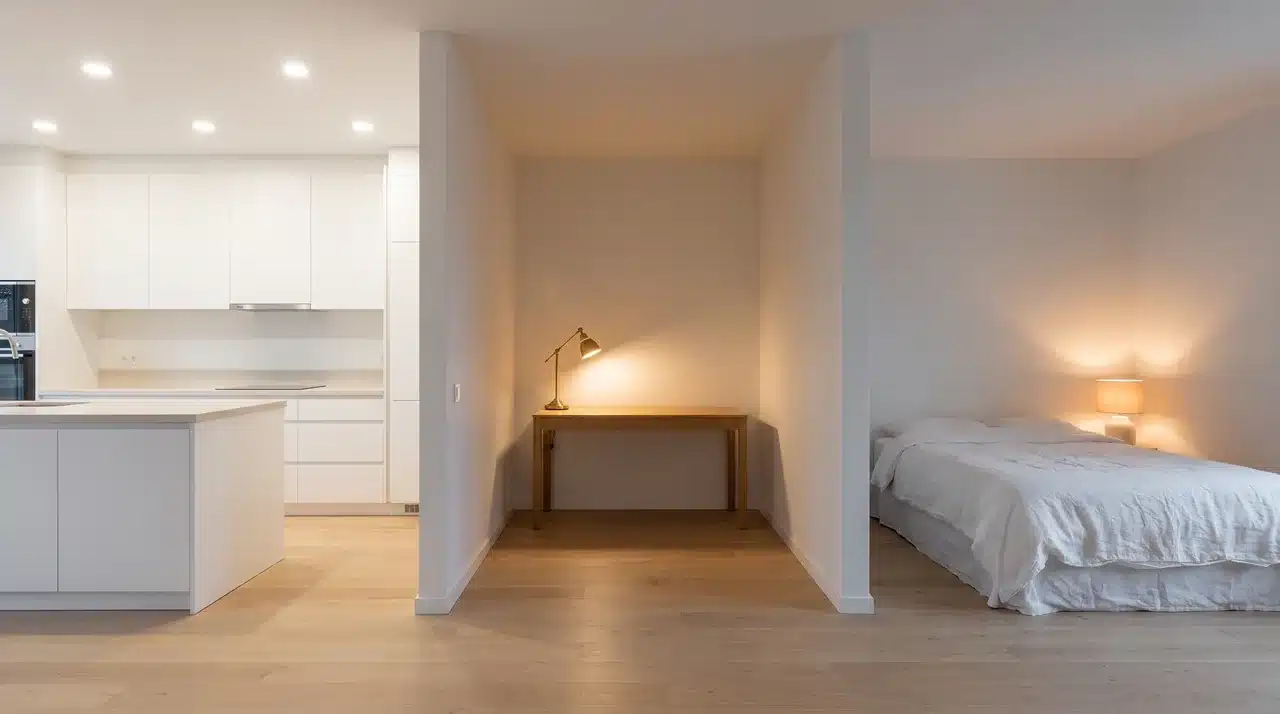
Some rooms rack up far more lighting costs than others simply because their lights stay on longer each day. Here’s how typical usage compares by room.
- Kitchen: Typically uses 0.4–0.8 kWh per day because lights often stay on during meal preparation, cooking, and cleanup.
- Living Room: Usually consumes 0.3–0.6 kWh per day, especially when overhead lights and lamps are used throughout the evening.
- Home Office: Generally uses 0.3–0.6 kWh per day, depending on the number of fixtures and daily working hours.
- Bedroom: Typically uses 0.1–0.3 kWh per day since lighting is usually needed only in the morning and before bedtime.
- Bathroom: Commonly consumes 0.1–0.2 kWh per day because lights are used for shorter periods throughout the day.
Kitchens and home offices are often the biggest contributors because their lights stay on for longer stretches throughout the day, rather than being used briefly, as with a bathroom or hallway light.
Do Lights Use a Lot of Electricity Compared to Other Appliances?
Lighting draws far less power than most other household appliances; even something like what a TV draws usually outpaces a bulb’s wattage by a wide margin. Here’s how a typical bulb stacks up against common devices.
| Appliance | Typical Watts |
|---|---|
| LED Bulb | 8–12W |
| Ceiling Fan | 60–90W |
| Television | 60–200W |
| Refrigerator | 100–400W |
| Microwave | 600–1,200W |
| Electric Heater | 1,500W |
| Air Conditioner | 1,000–3,500W |
According to the U.S. Energy Information Administration, lighting makes up roughly 6% of total residential electricity use nationwide. That’s a useful reference point: even a full LED upgrade won’t move your bill as much as fixing an inefficient HVAC system, but it’s one of the cheapest and fastest changes to make.
Conclusion
Understanding how much power do lights use helps you make smarter decisions about your home’s energy use without relying on guesswork.
I hope you can now see that a bulb’s wattage, the number of hours it runs, and the total number of lights in your home all affect your electricity bill.
Choosing LED bulbs, focusing on the rooms where lights stay on the longest, and using the simple kWh formula can all reduce unnecessary energy costs over time.
These small adjustments can lead to noticeable savings without sacrificing the brightness you need. Try calculating the energy use of your busiest room, and share your results or questions in the comments.
Frequently Asked Questions
How much electricity does a light bulb use per day?
A 10W LED running for five hours uses 0.05 kWh per day. A 60W incandescent running for the same five hours uses 0.3 kWh daily for identical brightness. Multiply either figure by your electricity rate to find the daily cost, then multiply by 30 to get a monthly estimate that reflects your actual usage.
Do lights make your electric bill go up noticeably?
A single bulb makes a small difference on its own. A fully lit home with incandescent bulbs across 20 or more fixtures for several hours daily results in a high annual cost. Switching the highest-usage rooms to LED first produces the fastest visible reduction without replacing every bulb at once.
How much does it cost to leave a light on all night?
A 10W LED running for eight hours overnight uses 0.08 kWh, costing under two cents at today’s average electricity rates. A 60W incandescent running the same eight hours uses 0.48 kWh, costing around nine cents per night at the current U.S. average of roughly 19 cents per kWh, which adds up to about 33 dollars annually from that single bulb.
Is it cheaper to turn lights off or leave them on?
With LED bulbs, turning off the lights whenever a room is empty always reduces energy consumption. LEDs incur no startup energy cost, so the off switch is the cheaper choice regardless of how briefly you leave the room. The old logic around fluorescent bulbs restarting does not apply to LEDs at all.