

Solar panels do not lose performance overnight, but even a small yearly drop can affect your long-term energy savings. If you own a solar system, you may wonder why output changes over time and what those changes actually mean.
I know it can be confusing to separate normal aging from signs of a real problem. This guide explains solar panel degradation, the main causes behind it, and how different factors influence the rate of energy loss.
You’ll learn how sunlight, voltage stress, temperature changes, and maintenance decisions affect your panels so you can protect performance and make smarter decisions about your system.
What is Solar Panel Degradation?
Solar panel degradation is the natural, gradual decline in a panel’s electrical output over time. It’s an expected part of how solar technology ages, not a sign of malfunction.
Most panels lose between 0.3% and 0.8% of their efficiency each year, with premium monocrystalline panels typically staying closer to the lower end of that range.
Manufacturers generally guarantee panels will still produce at least 80% of their original rated capacity after 25 years, a figure that ties closely into overall solar panel lifespan and when replacement actually becomes worth considering.
Importantly, this loss is measured against the panel’s original output rating, not against yesterday’s production, so the decline happens slowly and predictably, never all at once.
What Causes Solar Panels to Degrade?
Most explanations stop at naming the culprits. Each mechanism below operates through a distinct physical process, and knowing how they work helps you actually interpret your system’s performance data.
1. Light-Induced Degradation (LID)
When silicon cells first encounter sunlight, boron and oxygen atoms inside the cells bond together. Those bonds form defects that trap electrons before they can contribute to current flow, which is what causes the drop in output.
This happens fast: one to three percent within the first weeks of sun exposure. Once those defect sites fill up, the reaction stops completely.
LID is a one-time event, not an ongoing process, which is why year-two performance data makes a more reliable baseline than year-one.
2. Potential-Induced Degradation (PID)
High system voltage causes stray current to leak between solar cells and the aluminum frame. Left unaddressed, that leakage pulls electrons away from where they need to be, quietly reducing output year after year.
Caught early, though, the loss stays negligible and manageable.
PID is also the only degradation mechanism that’s partially reversible: running a low reverse voltage overnight, a feature available on some modern inverters, can drive stray ions back into place and recover lost output.
No other mechanism on this list offers that.
3. Thermal Cycling
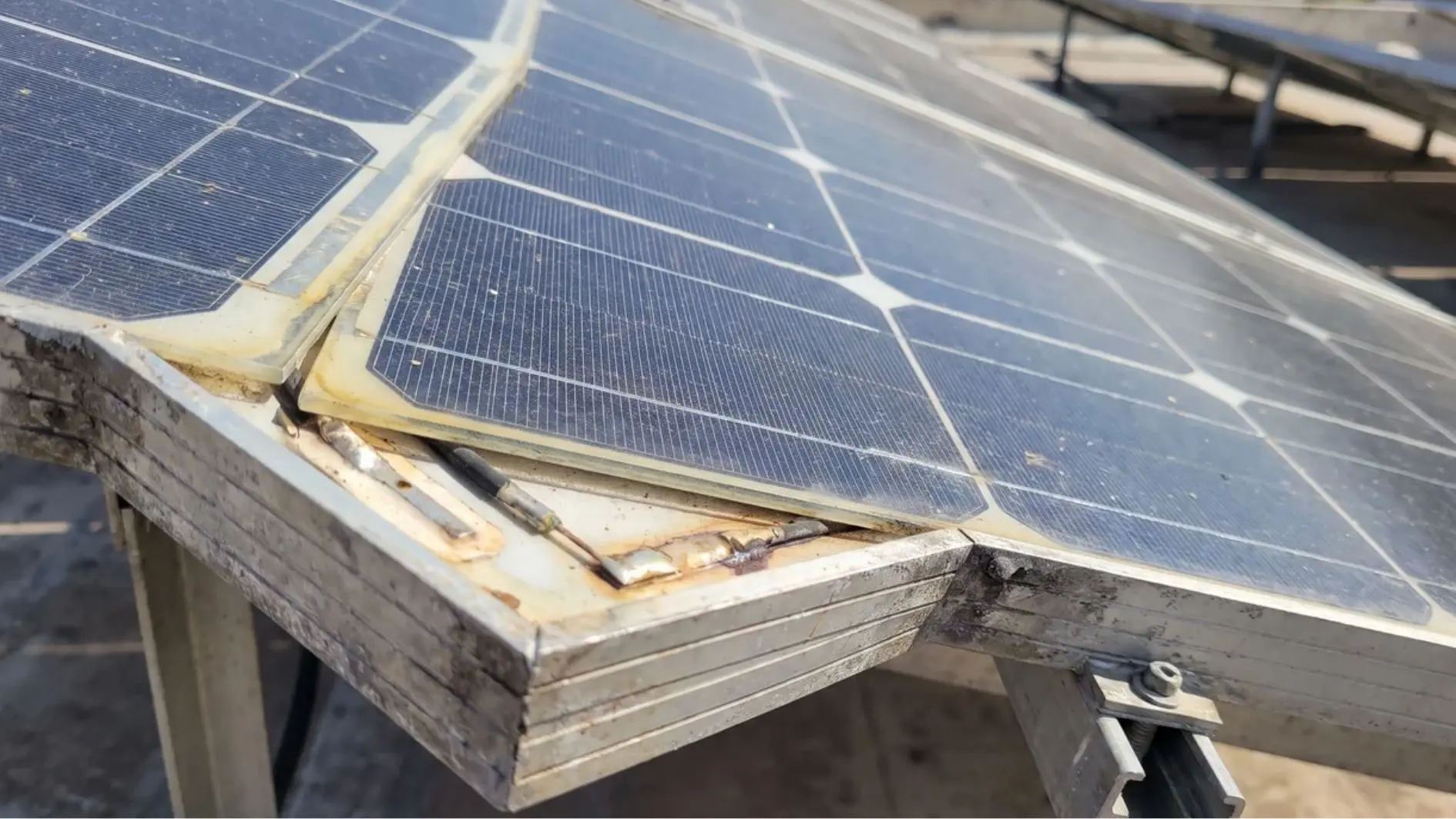
Panels heat up during the day and cool down at night, and that daily expansion and contraction puts repeated mechanical stress on the metal interconnects linking cells together.
Over the years, this creates microcracks too small to see, causing a slow, cumulative output loss rather than a sudden one.
UV exposure and moisture compound the problem from outside the cells: UV yellows the encapsulant layer that bonds cells to the glass, cutting how much light gets through, while moisture infiltration through weak seals causes delamination that scatters light and speeds up further breakdown.
What Solar Panel Degradation Is Not
Degradation doesn’t mean your solar panels are breaking down or about to stop working. It’s a slow, predictable decline in output, not a malfunction.
- It is not sudden power loss: a healthy panel’s output drops by a fraction of a percent each year, not all at once.
- It is not the same as a defect: a cracked cell, faulty wiring, or dead diode is a hardware failure, not degradation.
- It is not a sign your system is failing: even after 25 years, most panels are still producing meaningful power.
If your output drops sharply or abruptly rather than gradually, that points to an actual fault, not normal degradation, and is worth having inspected.
Why Degradation Rate Matters for Savings and Warranties
A difference of a few tenths of a percent in annual degradation sounds trivial, but it compounds significantly over 25 years. A panel degrading at 0.4% per year will still produce around 90% of its original output by year 25.
One degrading at 0.8% per year, twice the rate, drops closer to 80%, and the gap widens every year in between. Over a system’s lifetime, that difference can translate into thousands of kilowatt-hours of lost production, directly affecting your electricity savings.
This is where a manufacturer’s Performance Warranty matters. It guarantees your panels won’t fall below a specified output threshold, commonly 80%, within a set period, usually 25 to 30 years.
If your system’s actual output drops below that guaranteed level, you’re entitled to file a claim for repair or replacement, making the warranty a financial safety net against faster-than-expected degradation.
Conclusion
Solar panel aging is a natural process, but understanding it helps you avoid unnecessary concerns and unexpected performance issues.
I’ve covered how solar panel degradation happens, why factors like LID, PID, heat, and moisture matter, and how panel quality affects long-term output.
You can use this knowledge to monitor your system, recognize normal efficiency loss, and identify problems that need attention. A small difference in degradation rate can create a noticeable impact over decades, so choosing reliable equipment and maintaining your system matters.
Keep tracking your energy production, schedule inspections when needed, and use these insights to get the best possible performance from your solar investment.
Frequently Asked Questions
What is a normal solar panel degradation rate?
Most solar panels degrade at 0.3–0.5% per year after the first year’s initial drop. Premium monocrystalline panels from established manufacturers fall at the lower end of that range. Lower-tier panels can degrade at 0.7–1% annually. After 25 years, a panel at 0.5% annual degradation retains roughly 88% of its original output capacity.
What is light-induced degradation, and is it permanent?
Light-induced degradation is a rapid output drop of 1–3% that occurs in the first hours to weeks of sun exposure, caused by boron-oxygen defects forming inside silicon cells. It stabilizes quickly and does not continue at that rate. The initial drop is permanent, but the process effectively stops once the defect sites are saturated.
Does cleaning solar panels reduce degradation?
Cleaning removes soiling that reduces light transmission, but it does not address any of the four core degradation mechanisms. Dirt buildup temporarily affects output; degradation is a structural change within the cells. Regular inspection for microcracks, delamination, or PID symptoms is a more meaningful maintenance practice than cleaning frequency.
What is the difference between LID and PID in solar panels?
LID occurs in the first weeks of operation from a chemical reaction inside silicon cells triggered by sunlight. PID develops over years from voltage leakage between cells and the panel frame. LID is a one-time event that stabilizes; PID is ongoing and cumulative, but it is also the only degradation mechanism that can be partially reversed through corrective inverter settings.