


Ask five Virginia homeowners about solar incentives, and you will probably get five different answers, because there is not one program doing the work.
Virginia solar incentives come from a stack of separate pieces: tax credits, bill credits, and one-time exemptions, and each one pays out on its own schedule.
Some show up on your very first electric bill. Others take a full tax season to land, or years to add up.
Buying versus leasing changes which of these you can even touch, and today changed the federal side of the math more than most homeowners realize.
Once you see how each piece works on its own, a system that looked confusing on paper starts to look like something you can actually plan around, and that is where we are headed next.
Why Virginia Solar Savings Never Fit One Number?
Most homeowners start this research looking for a single payback figure, and that is usually where the confusion begins.
A tax credit, a bill credit, and a property tax break do not compound the way people expect. One shows up at tax time. One shows up every month.
One only applies if your system is small enough or your county has adopted it.
Add in the fact that buying, leasing, and financing a system unlock different combinations of these programs, and it is easy to see why two neighbors with identical roofs can end up with very different savings.
I checked the numbers behind each program separately, because that is the only way any of this actually adds up.
What Solar Incentives are Available in Virginia?
Virginia solar incentives include tax benefits, electricity bill credits, and production-based programs that reduce costs in different ways.
| Incentive | How It Saves Money | Who May Qualify | When Savings Occur |
|---|---|---|---|
| Federal solar tax credit | Reduces federal tax bill for owned systems (cash/loan buyers no longer qualify now) | Systems placed in service by December 31, 2025; lease/PPA customers indirectly | At tax filing, for eligible systems |
| Net metering | Credits your bill for extra power sent to the grid | Customers of Dominion Energy or Appalachian Power | Ongoing, on monthly electric bills |
| SRECs | Pays you for selling energy credits your system earns | System owners who register and sell through a broker | Ongoing, as credits are sold |
| Property tax exemption | Keeps added home value from raising your property tax | Homeowners in participating counties or cities | Ongoing, at annual assessment |
Combining more than one program often changes your total cost more than looking at any single incentive alone.
Understanding the Federal Solar Tax Credit in Virginia
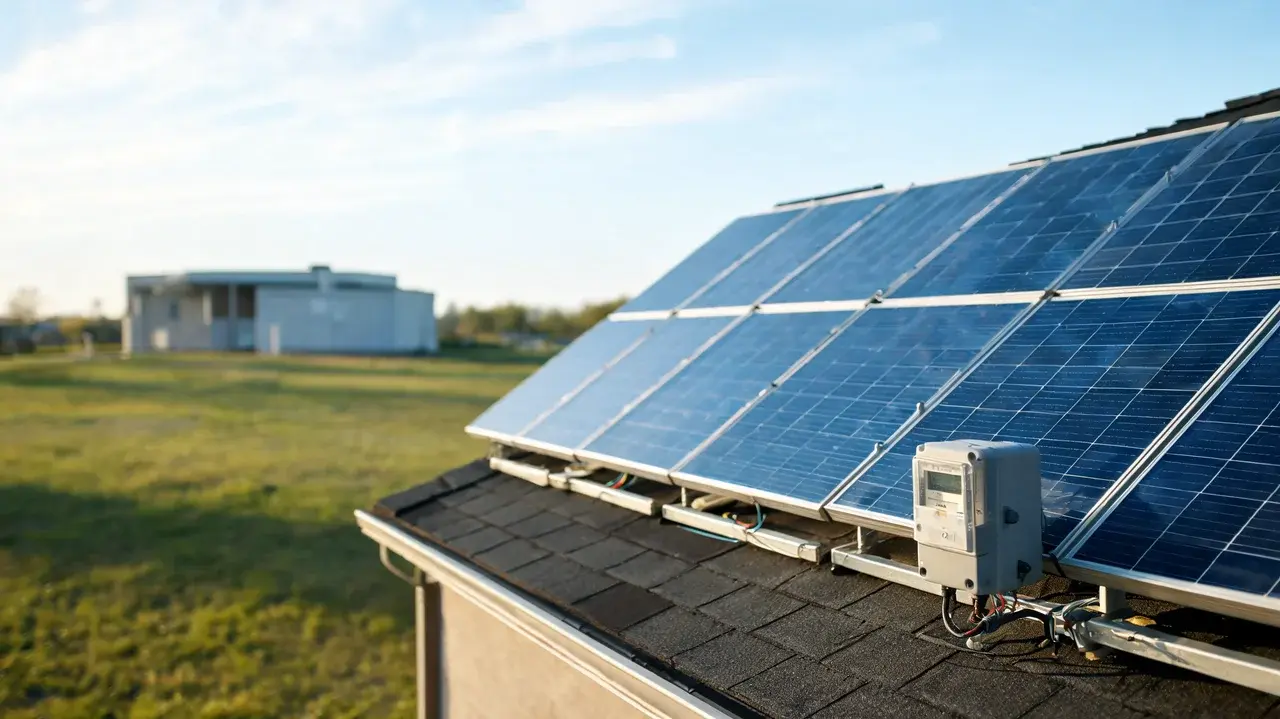
The federal solar tax credit reduces federal income taxes by a percentage of qualifying solar installation costs for eligible homeowners, though the rules have changed.
According to the Congressional Research Service, the One Big Beautiful Bill Act repealed the residential solar tax credit for expenditures made after 2025.
The 30% Residential Clean Energy Credit under Section 25D no longer applies once installation is completed after December 31, 2025, per IRS guidance.
If you purchase your system outright as of now, you will not receive this credit.
If you placed your system in service on or before that date, you can still claim 30% on your return. Lease and PPA customers are not entirely shut out.
The company that owns the equipment can still claim the commercial credit under Section 48E, but the timeline is specific: projects that began construction by July 4, 2026 keep a longer runway, while newer projects must be placed in service by December 31, 2027 to qualify.
Some leasing companies pass part of that value along through a lower monthly rate.
This is the ownership distinction that shapes access to several other incentives too: buying your system generally opens up more benefits than leasing it.
In conversations with homeowners weighing this decision, the ones who end up unhappy almost always skipped reading the buyout terms before signing, not the monthly rate itself.
If you are comparing the two paths, how solar leases handle the tax credit is worth reading before you sign anything.
Qualifying costs, for systems that still qualify, generally include:
- Solar equipment: Panels and related hardware.
- Installation labor: The cost of professional installation.
- Related fees: Permitting and other project-tied charges.
Eligible homeowners file IRS Form 5695 with their federal tax return for the year the system started running.
The Role of Net Metering and SRECs in Reducing Solar Costs
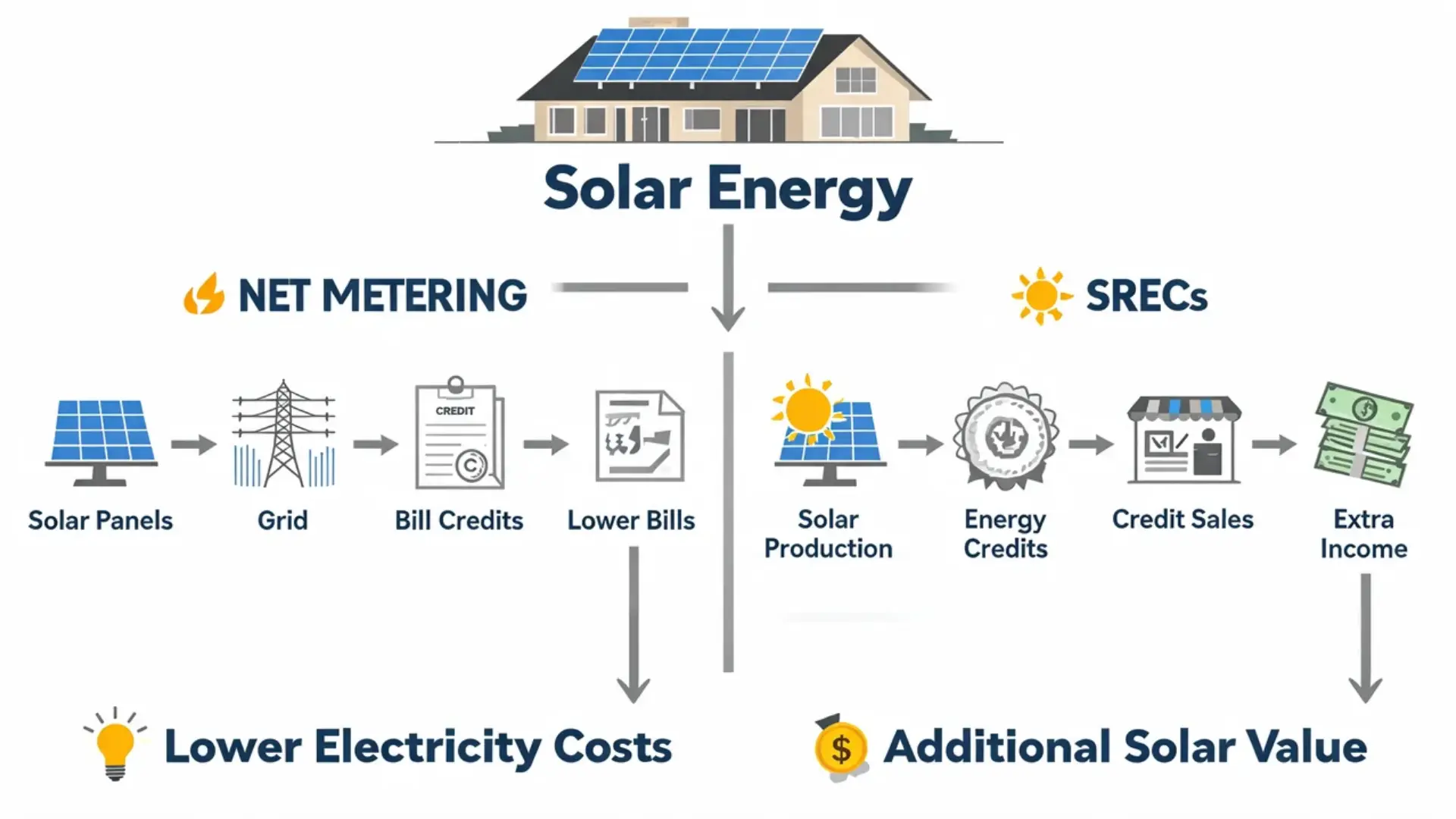
Net metering lowers electricity costs through bill credits, while SRECs create value from the renewable energy your system produces. Both reward solar generation, but they pay out differently.
When your panels produce more electricity than your home uses, the extra power flows back to the grid, and your utility credits your account for it.
According to Solar United Neighbors, Dominion Energy and Appalachian Power both credit net metering customers at the full retail rate for systems under 25 kW.
Those credits offset electricity you pull from the grid later, like at night, so you are credited close to what you would normally pay.
Smaller municipal utilities and electric cooperatives are not required to participate. System size matters too.
Participating systems generally need to stay under 25 kW and cannot be sized to produce more than your home typically uses in a year. You will also need utility approval before your system connects to the grid.
Both utilities also cap how much total solar capacity can enroll each year, so participation runs first-come, first-served rather than guaranteed.
Regulators rejected proposals from both Appalachian Power and Dominion Energy to cut net metering credits in 2025 and 2026, so the full retail rate is holding for now, but it is worth confirming with your utility before you finalize a system size.
Unused credits usually roll over month to month, and terms vary by utility for what happens to leftover credits at the end of a billing cycle.
How Virginia SRECs Work
An SREC represents solar electricity production, usually one credit per megawatt-hour generated. Unlike net metering, SRECs aren’t tied to your electric bill.
These credits get sold instead. Utilities buy them to meet state clean-energy requirements, and homeowners typically sell through a broker.
Prices move with demand, so treat any dollar estimate as a range, not a guarantee.
Some states run a much more active SREC market than Virginia does right now; New Jersey’s SREC program is a useful comparison if you want to see what a mature market looks like.
To start, register your system with your utility, then work with a broker to handle sales.
Both programs can add value, but the amount depends on your production and current program terms.
Solar Tax Exemptions and Rebates Available in Virginia
Virginia allows certain solar property tax exemptions, but the rules differ depending on your system size.
Under Virginia Code § 58.1-3661, residential solar systems of 25 kW or less are automatically exempt from state and local property taxation, a change that took effect in 2023.
For larger or non-residential solar equipment, counties, cities, and towns may still choose, by ordinance, to exempt or partially exempt that equipment from local taxation.
Some localities apply a graduated schedule for equipment that is not automatically exempt, covering a larger share of the added value in early years and less over time.
- Property tax exemption: reduces or removes the added tax burden from your system’s value, automatically for systems under 25 kW.
- Local programs: some counties and cities offer their own incentives, like green building credits.
- Utility programs: some providers offer their own rebates tied to specific equipment.
Two homeowners with identical systems in different towns could still see different results for anything above the automatic exemption threshold.
How Much Can Virginia Solar Incentives Save You?
Virginia solar savings depend on system size, electricity use, utility rules, and how you purchase your system. No single number applies to every home. Here’s a simple breakdown using a 6 kW system:
| Item | Detail |
|---|---|
| Upfront cost | Around $17,700 before any incentives |
| Federal tax credit | $0 if bought with cash or a loan, since the credit no longer applies to new purchases (a system placed in service by the end of 2025 would have qualified for roughly $5,310) |
| Yearly savings | Around $1,378 from reduced electricity costs, based on the system producing close to 9,190 kWh a year. |
| Estimated payback | Without the federal credit, recovering the full $17,700 through yearly savings alone takes noticeably longer than the 9-year figure often quoted for older installations; sources point to a broader 9- to 12-year range depending on system size and local electricity rates, though that range generally assumes the federal credit was still active. |
Virginia’s average residential electricity rate has climbed since older payback estimates like this one were first calculated, so your actual yearly savings could run higher than the figure above.
Ask your installer to calculate savings using your utility’s current rate, not a rate from a year or two ago.
The most reliable way to know your real savings is a personalized quote, since an installer can factor in your roof, electricity use, and local incentives directly.
Claiming Virginia Solar Incentives: What You Need to Do
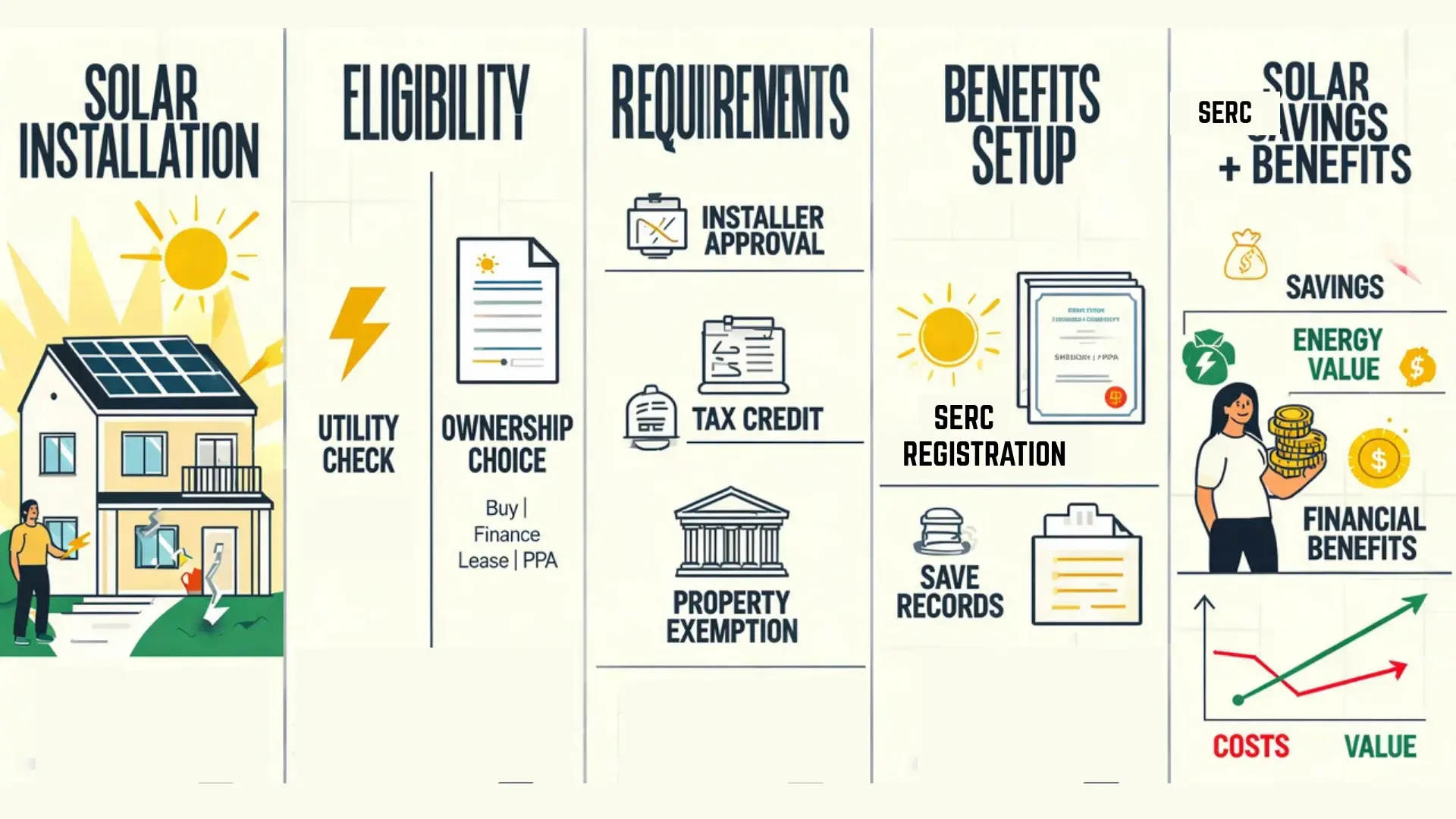
Claiming solar incentives means checking eligibility, completing the right applications, and keeping project records. Some steps happen before installation.
- Confirm your utility: Check whether Dominion Energy, Appalachian Power, or a smaller provider serves your home, since this determines your net metering rules.
- Check your ownership structure: Buying, financing, leasing, or a PPA changes which incentives you can access directly.
- Review your installer’s paperwork: A qualified installer typically handles interconnection notifications and utility approvals, but confirm this before signing. If you are curious what that process actually looks like on the roof itself, installing panels step-by-step walks through it.
- Complete required tax forms: If your system qualifies, file IRS Form 5695 with your federal tax return.
- Apply for local property tax exemptions: Systems under 25 kW qualify automatically, but larger systems still need to contact the city or county directly.
- Register for SRECs, if applicable: Connect your system to the grid, then register with a broker to handle sales.
- Keep every document: Save contracts, invoices, approval letters, and utility correspondence as you go.
Organized records make it easier to claim each benefit and compare your actual savings against your original quote.
Final Overview
Virginia solar incentives add up to real savings, but only if you understand which piece pays out when.
Net metering and the property tax exemption for smaller systems work automatically once you qualify.
The federal credit and SRECs take more paperwork, and the federal credit now depends heavily on whether you buy or lease.
None of these programs replace a personalized quote, but knowing how each one works means you will actually understand the number your installer hands you.
Have you gone solar in Virginia recently? We would like to hear what your actual payback looked like once the dust settled.
Frequently Asked Questions
Does Virginia Have a State Solar Tax Credit?
Virginia does not offer a general state income tax credit for solar. Homeowners can instead use the automatic property tax exemption for systems under 25 kW, SRECs sold through a broker, and net metering credits on their monthly bill. Combined, these programs often do more work than a single state credit would, especially for smaller residential systems.
Can You Get Free Solar Panels in Virginia?
Not usually. A lease or PPA can lower your upfront cost close to zero, but the leasing company owns the system, which means you cannot claim SRECs or the property tax exemption yourself. The company may claim the federal commercial credit instead and pass part of that value along through a lower monthly rate.
Is Virginia’s Net Metering Program at Risk of Changing?
Both Appalachian Power and Dominion Energy proposed cutting net metering credit rates in recent years, but state regulators rejected the bulk of those proposals and kept the full retail rate in place. Nothing is guaranteed long-term, since utilities can file new proposals, but as of now, the retail-rate credit that makes Virginia net metering valuable is still intact.
How Long Do Net Metering Credits Last in Virginia?
Virginia utilities generally use a 12-month netting period, so credits from a sunny summer can offset a higher winter bill within that same cycle. Any credit still unused at the end of the 12 months is typically paid out at a lower avoided-cost rate instead of the full retail rate, so terms are worth confirming directly with your utility.